
What if the best garden upgrade is the one that makes everyday life easier, not simply the one that looks impressive? Choosing landscape gardeners Greenbank homeowners can rely on starts with how you use your outdoor space, what your property needs and which improvements work well together. A new lawn, paved area or retaining wall can each play a part, but the plan should make sense as a whole.
It can be hard to decide what to prioritise or how separate jobs will come together. Before work begins, you want clear decisions and a finished garden that suits your home and household. This guide helps you set priorities, account for your property and day-to-day routines, and plan connected improvements.
Based in Greenbank, INEX Landscaping works across South East Queensland on landscaping and gardening, turf and artificial grass installation, paving, retaining walls and fencing. Here’s how these services can support practical garden goals and what to consider as you plan your outdoor space.
Key Takeaways
- Start your garden brief with the people, routines and activities your outdoor space needs to support.
- Check how slope, access and existing features can shape the site plan and order of work.
- Compare natural turf and artificial grass by intended use, upkeep and the finish you want for your property.
- Prepare for a landscaping project by identifying priority areas and noting access and existing features.
- See how landscape gardeners Greenbank homeowners can work with can coordinate turf, paving, retaining walls and fencing around your garden goals.
Landscape gardeners in Greenbank: start with what your yard needs
Your outdoor space might need to work harder for your household, take less effort to maintain or simply feel more inviting. Before choosing finishes or features, decide what you want the garden to make possible. For homeowners considering landscape gardeners Greenbank, that means looking beyond appearance to how people move through and use the yard each day.
A landscaping brief is a clear summary of the project’s goals, site needs and preferred outcomes. Start by listing who will use each area and what they need to do there. Children might need room to play, while adults may want a place to unwind or entertain. Consider the routes between the house, clothesline, shed and side gate, as well as whether views into the yard affect your privacy.
These choices influence one another. An entertaining area may need a direct route from the house, while a play lawn should be easy to reach and keep an eye on. Thinking through the principles of landscape design can help you see how layout, use and appearance work together. Keep the plan grounded in your household’s routines rather than adding features that may go unused.
What should a Greenbank garden project achieve?
Picture a typical week, not just a special occasion. Who uses the garden, what do they do there and how much time can they give to upkeep? Separate essentials from optional extras. A clear access route or usable lawn might be a priority; an additional seating area could wait. This helps shape a workable scope around your property and the people who will maintain it.
- Daily use: Identify space for play, relaxing, entertaining or moving between outdoor areas.
- Access: Note gates, paths and narrow points that make carrying items or reaching parts of the yard awkward.
- Privacy: Consider where screening or fencing could make an area more comfortable.
- Upkeep: Be realistic about who will care for lawns, plants and other garden features.
Which parts of the yard need attention first?
Look for patterns, not just isolated eyesores. A worn lawn may reflect heavy foot traffic or a layout that sends people across the same patch. An awkward side passage could need clearer access, while an unused corner might work better if it connects to the main garden. Greenbank properties vary, so assess your own slope, boundaries, existing features and entry points rather than assuming a standard block layout.
Visible problems can also point to broader project needs. If a change in level limits how you use an area, consider the layout alongside a retaining wall. If the entertaining space feels disconnected from the house, plan paving and access routes together. Make a short walk-through list of what isn’t working, where it happens and who it affects. This gives your landscaper a practical starting point for turning household priorities into a coordinated plan.
How Greenbank landscape gardeners turn a vision into a site plan
A site plan turns household priorities into a practical sequence of work. For landscape gardeners Greenbank homeowners engage, the process starts by agreeing on what the garden needs to do, then considering how the property can support that vision. Treating features as connected decisions helps the finished yard feel cohesive, from the lawn and paths to garden areas and boundaries.
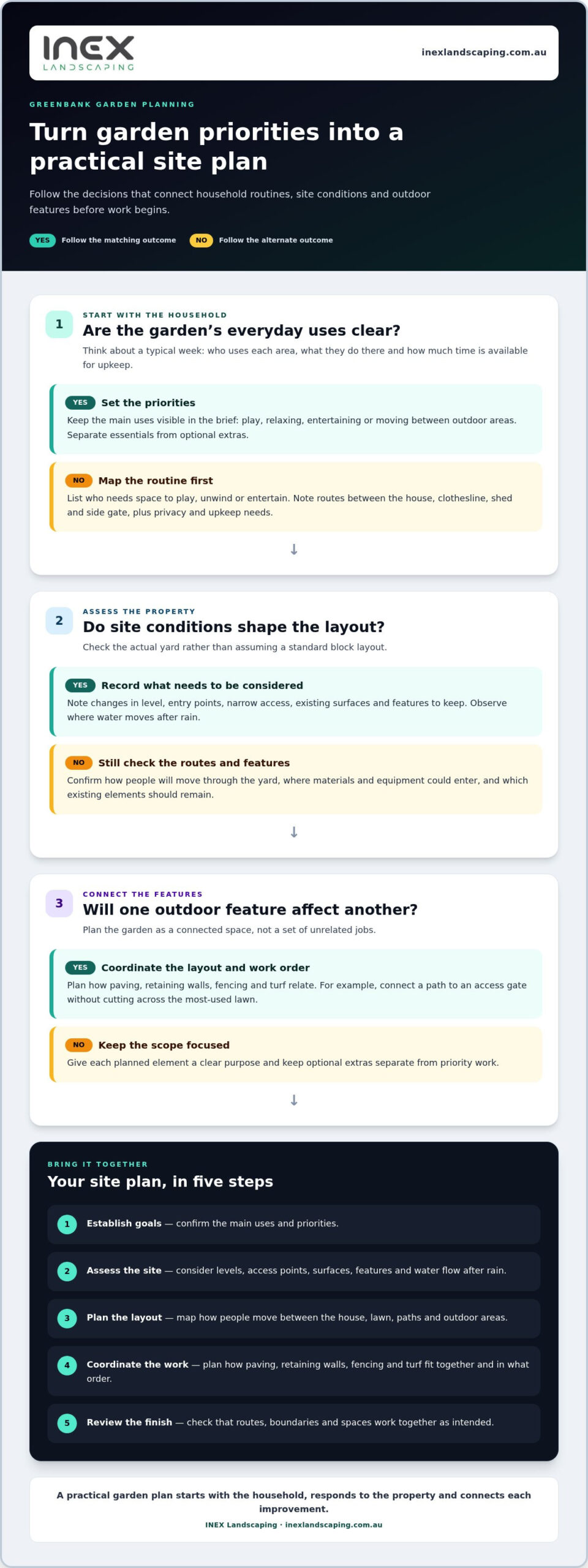
- Establish goals. Confirm the main uses and priorities, such as a lawn for everyday activity, a more direct route across the yard or a defined entertaining area.
- Assess the site. Look at levels, access points, existing surfaces and features. Notice where water appears to flow after rain.
- Plan the layout. Map how people will move between the house, lawn, paths and other outdoor areas. Check that each element has a clear purpose.
- Coordinate the work. Consider how paving, retaining walls, fencing and turf relate to one another, and plan their order before installation begins.
- Review the finish. Walk through the completed areas and consider whether routes, boundaries and spaces work together as intended.
Site conditions should shape landscaping decisions. The same layout or finish won’t suit every combination of levels, access, existing surfaces and intended use. A good plan responds to the property rather than forcing it into a standard template. The National Park Service’s discussion of Frederick Law Olmsted’s design principles also offers useful context on balancing function and visual quality in outdoor spaces.
How do site conditions shape the garden plan?
Begin with a practical walk-through. Note where equipment and materials could enter, where levels change and which existing surfaces or features should remain. Observe how water moves across the yard rather than assuming a drainage issue from appearance alone. These details can affect the layout and choices for each area, helping the design respond to the site.
For example, a path may need to connect an access gate with a paved area without cutting across the most-used lawn. A change in level may influence where a retaining wall fits. These are site-specific decisions: the aim is to make the separate parts function together while taking existing conditions into account.
How can separate outdoor jobs work as one project?
Think of the garden as a connected plan. Paving can define a route or usable outdoor area; turf can provide open space beside it; fencing can establish the boundary; and a retaining wall can address a change in level. Considering these elements together helps avoid placing one feature where it complicates another. The Greenbank landscaping services buying guide explains how related improvements can fit into a broader project.
Work sequence matters, too. Consider the layout and structural elements before finishing surfaces or laying turf, so later work doesn’t disrupt completed areas. A coordinated plan gives each task a place in the overall job. To bring related outdoor improvements together, explore INEX Landscaping’s coordinated garden work.
Compare garden landscaping choices by function, upkeep and finish
Each landscaping element solves a different problem, so compare options by how you’ll use the space and care for it. Natural turf provides a living lawn, while artificial grass creates a finished lawn area without mowing. Paving can clarify routes or create a defined outdoor living space; retaining walls can help manage level changes and form garden zones. Fencing defines boundaries and can support privacy.
Use this overview to decide which options belong in your project brief. The right combination depends on your property, household routines and preferred finish.
| Choice | Purpose | Upkeep considerations | Useful project context |
|---|---|---|---|
| Natural turf | A living lawn for play, relaxation or open space. | Needs ongoing lawn care, including mowing and attention to its growing conditions. | Consider it where a natural surface and lawn-care routine suit the household. |
| Artificial grass | A finished lawn area without mowing. | Still needs care to keep the surface tidy and clear of debris. | May suit areas where a consistent lawn appearance is a priority. |
| Paving | Defines a path, access route or outdoor living area. | Consider how the surface will be used and kept clean. | Useful where people need a clear route or a firm, designated space. |
| Retaining walls | Manages level changes and helps shape garden zones. | Plan around the site’s levels and how adjacent areas will be used. | Consider where a change in level affects the layout or usable space. |
| Fencing | Defines a boundary and can support privacy. | Allow for ongoing care appropriate to the fence and surrounding area. | Useful when boundaries or separation between areas are part of the brief. |
Natural turf or artificial grass: which suits your routine?
Start with the lawn’s intended role. If you value a living surface and are prepared to care for it, natural turf may fit your routine. If avoiding mowing is a priority, artificial grass may suit, though it still needs attention to stay presentable. Neither option suits every property or household. Compare intended use, preferred appearance and the maintenance you’re comfortable managing. For more detail on this option, see the artificial grass installation guide for Greenbank.
When do paving and retaining walls add practical value?
Paving is useful when you want clearer access or a defined area for entertaining. A retaining wall can help manage a change in level and make the layout more usable, with garden zones planned around it. Consider both alongside lawn placement and boundaries, not as isolated additions. Landscape gardeners Greenbank homeowners work with can coordinate these choices as part of a broader project plan.
Upkeep is part of the decision, too. The US Environmental Protection Agency’s guidance on sustainable landscaping practices highlights the value of considering local conditions when planning an outdoor space. Use the comparison to prioritise features, then shape the overall mix around how you want the garden to function.
Prepare for a landscape gardening project in Greenbank
A little preparation makes it easier to define the project scope. Before speaking with landscape gardeners Greenbank homeowners should have a practical picture of what needs to change, what must stay and how the household will use the finished space. A clear brief helps keep decisions focused on everyday needs as well as the preferred look.
Use this sequence to organise the key information:
- Set your goals. Write down the main outcome you want, such as a more usable lawn, easier access or a defined paved area.
- Mark priority areas. Identify what needs attention first and distinguish essential work from features that could be considered later.
- Note site details. Record existing surfaces, changes in level, gates and access routes, along with features you want to keep undisturbed.
- Gather references. Collect inspiration images and note practical must-haves, such as preferred colours, uses or areas that need privacy.
- Consider site access. Think about how people, equipment and materials could reach the work area, and whether anything may need to be moved beforehand.
What should homeowners organise before work starts?
Before work begins, clear the agreed access route as much as practical and point out garden features that should remain undisturbed. Share inspiration images and explain what appeals to you in each one, whether that’s the layout, colour or overall feel. Add your non-negotiables too. Making these decisions early gives the project discussion a useful reference point and helps reduce uncertainty as the scope takes shape.
Consider how the garden will be used during the work. Note household access needs and identify areas that should remain available where possible. These details help set practical expectations around the work area without assuming every property has the same constraints.
How can the project scope stay clear?
The scope and site requirements inform the work plan and quote. Materials, access, existing features and selected improvements all affect what the project involves. Timing also depends on the project scope, site conditions and work requirements, so it’s best considered in relation to the specific job.
INEX Landscaping can bring related outdoor construction and landscaping tasks into one project discussion. For instance, consider a paved area alongside access routes, lawn edges or a change in level, rather than treating it as an isolated feature. The Greenbank paving installation guide can help you think through how paving fits into the wider garden plan.
Keep decisions manageable by agreeing on priority areas first, then considering how the selected features connect and what preparation each requires. To discuss a coordinated project for your property, talk with INEX Landscaping about your garden plans.
Choose INEX Landscaping for garden projects in Greenbank
INEX Landscaping is based in Greenbank and works with residential and commercial clients in nearby South East Queensland communities, including Yarrabilba, Parkridge, Marsden, Bahrs Scrub and South Maclean. If you’re looking for landscape gardeners Greenbank homeowners can work with on connected outdoor improvements, INEX can bring the separate parts of a garden project into a considered plan.
What can INEX bring together in an outdoor project?
Garden goals often involve more than one type of work. A new lawn may need to connect neatly with a paved path, while fencing can define the boundary and a retaining wall can help shape an area where levels change. INEX provides landscaping and gardening alongside complementary outdoor construction work, so related elements can be considered as parts of the same project.
- Turf or artificial grass: Create a lawn area suited to your preferred look and how the space will be used.
- Paving: Define a path, access route or outdoor area.
- Retaining walls: Help shape garden zones around changes in level.
- Fencing: Establish boundaries and support privacy.
- Stump grinding or construction site cleaning: Address site preparation or post-work cleanup where relevant to the project.
Considering related work together can help keep the layout and finish consistent. For example, planning paving alongside the lawn edge and fence line helps each element relate to the others instead of competing for space. The right combination depends on your property, priorities and the work required.
How do you take the next step with INEX?
Start with a simple outline of your project. Include your property location, the areas you want to improve and the outcome you’re aiming for. Note existing features you want to retain, access considerations and any work that feels most urgent. Inspiration images can communicate the look you have in mind, while practical details explain how the garden needs to function.
INEX can shape a project-specific scope and quote around your site and selected work. If your plans include several connected tasks, discussing them together helps clarify how turf, paving, retaining walls, fencing or relevant preparation and cleanup fit into the project. The scope can reflect the work your property needs rather than a one-size-fits-all package.
Ready to make a start? Discuss your Greenbank garden goals with INEX Landscaping and request a tailored project quote.
Make your garden plans the start of something better
A garden project doesn’t need every detail decided before you begin. Start with the change that would make the biggest difference to your day, then build the plan around your property and household. That clear priority gives landscape gardeners Greenbank a practical direction for shaping work that feels considered, not pieced together.
Before taking the next step, jot down what you’d like to improve, what matters most and any questions you want to discuss. Notes about how you use the garden can turn an idea into a practical conversation about the right scope for your home. From there, make decisions with the finished space in mind.
INEX Landscaping works with homeowners and commercial clients on landscaping and related outdoor construction projects across Greenbank, Yarrabilba, Parkridge, Marsden, Bahrs Scrub and South Maclean. Discuss your Greenbank garden project with INEX Landscaping and request a tailored quote to get started.
Frequently Asked Questions
Can landscape gardeners help redesign an existing Greenbank yard?
Yes. Landscaping can improve the layout and everyday use of an established garden, not just shape a new build. INEX provides landscaping and gardening alongside turf, paving, retaining walls and fencing, which can help address connected changes. Before discussing the work, describe what currently functions well, what causes frustration and how you’d like to use the space. That gives the project scope a practical starting point.
What should I include when requesting a landscaping quote in Greenbank?
Share your property location, the areas involved and how you want to use them. Include preferred features, such as a lawn or paved access route, and note gates, narrow passages or other site access considerations. Mention existing elements you want to retain, too. Site conditions, selected materials and the work required all shape a tailored quote, so useful project details help explain what the job involves.
Can one landscaping project include turf, paving and a retaining wall?
Yes, a project can bring these elements together if they suit the site and overall layout. Turf can provide usable green space, paving can define a route or outdoor surface, and a retaining wall can help manage a change in level. INEX provides each of these services, but the right combination depends on the property. Considering their placement together helps the finished garden feel coherent and practical.
Do landscape gardeners work on commercial properties as well as homes?
Yes. INEX Landscaping works with residential and commercial clients, with the project scope shaped around the property’s use and site access. For example, a commercial outdoor area may need clearly defined access or usable surfaces, while a home garden may prioritise lawn space or privacy. INEX serves Greenbank, Yarrabilba, Parkridge, Marsden, Bahrs Scrub and South Maclean, with work including turf, paving, fencing and construction site cleaning.
How do I choose between natural turf and artificial grass for my Greenbank property?
Choose based on the appearance you prefer, how the lawn will be used and the upkeep you’re prepared to manage. Natural turf is living grass that requires lawn care; artificial grass is a synthetic surface with different maintenance needs. Neither option is automatically right for every yard. For more detail on product and installation considerations, read INEX’s artificial grass installation guide.
Can landscaping work include removing a tree stump before the garden is installed?
Yes. Stump grinding is an INEX service and may be relevant if a stump occupies space intended for a lawn, path or garden feature. Whether it belongs in the project depends on the stump’s location and the planned layout. Mention it when describing the areas you want to change, so site preparation can be considered alongside the garden improvements rather than as an afterthought.