
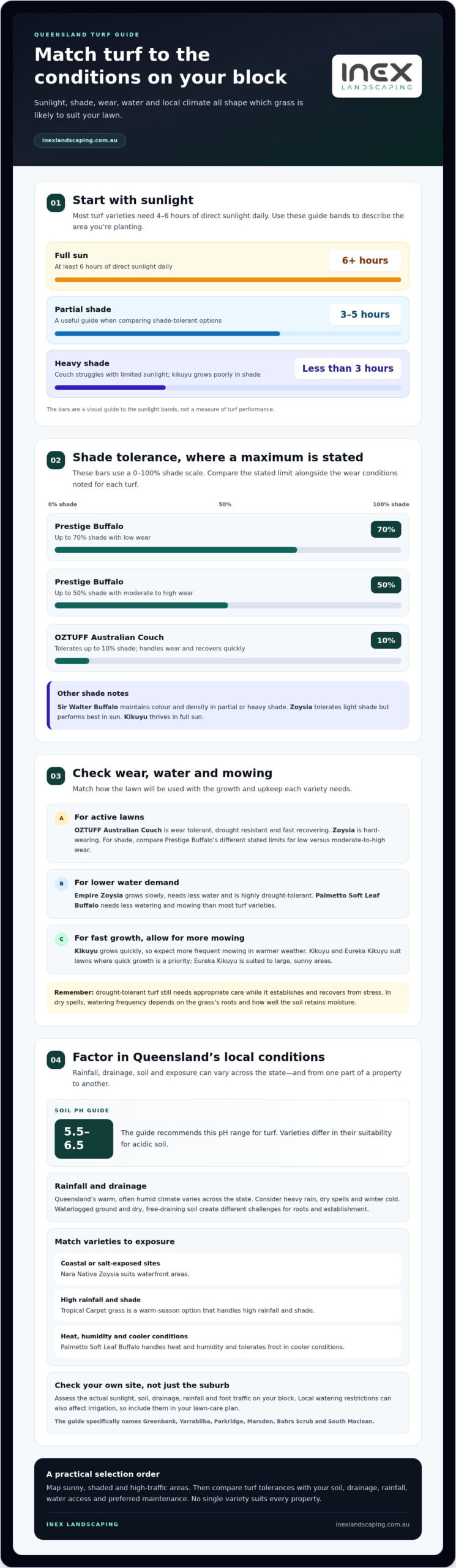
The best turf for a Queensland property is the variety that suits its sunlight, soil, drainage, rainfall and expected foot traffic. To work out how to choose a turf variety in Queensland, compare those site conditions with each grass’s shade, drought and wear tolerance, plus the maintenance it needs. As a guide, full sun means at least 6 hours of direct sunlight daily, while heavy shade means less than 3 hours.
Choosing turf by colour alone can lead to a lawn that struggles with its site. This guide compares common options and explains how sunlight, climate, soil and maintenance affect how to choose a turf variety in Queensland. Use the practical checks to narrow the choices for your property.
Key Takeaways
- Match grass to the lawn’s shade and wear: buffalo can tolerate substantial shade, while kikuyu performs best in full sun.
- Compare drought tolerance and water needs alongside growth and mowing habits to find a lawn that suits your upkeep preferences.
- Factor in Queensland’s local climate, soil, drainage and rainfall, as well as how much foot traffic the lawn will get.
- Use those site conditions to narrow your options before choosing turf, rather than selecting by appearance alone.
Suitable weather conditions?
Sir Walter buffalo keeps colour and density in partial or heavy shade, while couch struggles with limited sunlight. Zoysia tolerates light shade and handles drought, but performs best in sun; kikuyu thrives in full sun and grows poorly in shade. Most turf varieties need 4 to 6 hours of direct sunlight daily. As a guide, full sun means at least 6 hours, partial shade 3-5 hours, and heavy shade less than 3 hours.
Compare the lawn’s wear, water supply and mowing demands as well as its light. Prestige Buffalo tolerates up to 70% shade with low wear, or up to 50% with moderate to high wear. For active lawns, OZTUFF Australian Couch is wear tolerant, drought resistant and fast recovering. Kikuyu grows quickly, so expect more frequent mowing in warmer weather.
Water needs vary, too. Empire Zoysia grows slowly, needs less water and is highly drought-tolerant. Palmetto Soft Leaf Buffalo needs less watering and mowing than most turf varieties. In dry spells, watering frequency depends on the grass’s roots and how well the soil retains moisture. Even drought-tolerant turf needs appropriate care while it establishes and recovers from stress.
| Turf option | Shade and sun | Wear and recovery | Water and mowing |
|---|---|---|---|
| Sir Walter buffalo | Maintains colour and density in partial or heavy shade | Shade-friendly choice | Compare its upkeep with your site’s water supply |
| Couch, including OZTUFF | Best in sun; OZTUFF tolerates up to 10% shade | OZTUFF handles wear and recovers quickly | Drought resistant |
| Zoysia, including Empire | Light shade, with plenty of sun preferred | Hard wearing | Empire needs less water and mowing |
| Kikuyu | Thrives in full sun | Fast-growing | Frequent mowing in warmer weather |
To choose turf in Queensland, match the varieties in the table to your lawn’s sunlight, traffic and water access. Then compare their maintenance needs and drought performance.
Choosing turf for Queensland’s climate
Queensland’s warm, often humid climate varies across the state, so consider rainfall and drainage as well as sunlight. In Greenbank, Yarrabilba, Parkridge, Marsden, Bahrs Scrub and South Maclean, assess your property’s actual conditions rather than relying on a broad regional label. Heavy rain, dry spells and winter cold can all affect lawn performance.
For coastal or salt-exposed sites, Nara Native Zoysia suits waterfront areas. Tropical Carpet grass is a warm-season option that handles high rainfall and shade. Compare each variety’s tolerances with the exposure and conditions on your block.
Soil is another deciding factor. The guide recommends a pH of 5.5-6.5 for turf, and varieties differ in their suitability for acidic soil. Check drainage, too: waterlogged ground and dry, free-draining soil create different challenges for roots and establishment.
Winter conditions matter, too. Palmetto Soft Leaf Buffalo handles heat and humidity and tolerates frost in cooler conditions. For a full-sun lawn with regular foot traffic, compare wear resistance and growth habits: fast-growing kikuyu needs frequent mowing. Drought-tolerant grass can reduce water demand, but still needs suitable conditions to establish.
No single turf variety suits every property. Match the grass to your soil, rainfall, drainage and lawn use, then weigh maintenance against climate tolerance. Local watering restrictions can affect irrigation, so factor them into your lawn-care plan.
A practical next step is to map sunny, shaded and high-traffic areas before planning the lawn. That site picture helps narrow options for a Queensland turf project.
INEX Landscaping: Artificial Grass Supply & Installation
INEX Landscaping installs lawn and turf for Queensland properties where natural grass suits the site’s sunlight, soil and intended use. If regular watering or mowing is a concern, artificial grass supply and installation offers an alternative to living turf.
When planning a new lawn or outdoor upgrade, consider how the turf will work with the surrounding space and its intended use. INEX Landscaping also provides retaining walls and paving for outdoor projects.
Contact INEX Landscaping to discuss your turf or artificial grass project.
Plan the lawn around how you’ll use it
Before choosing a variety, picture how you want the finished outdoor space to function. Mark walking routes, shaded areas and the connections between the lawn, paths, entertaining areas and garden beds. These details turn the question of how to choose a turf variety in Queensland into a practical plan for your property.
Consider the whole layout, not just the grass. A well-planned space can be easier to maintain and feel more cohesive. If your plans include natural or artificial grass, retaining walls can help shape the area.
INEX Landscaping can help bring your turf plans together. Contact INEX Landscaping about your turf project, and take the next step towards an outdoor space that suits your home.
Frequently Asked Questions
How do I compare turf varieties for my property?
Compare varieties with the conditions in each part of your yard, not just the block as a whole. Note where children or pets run, where water collects and where spreading grass could overtake garden edges. For homes in Greenbank, Yarrabilba, Parkridge, Marsden, Bahrs Scrub or South Maclean, a simple site plan can help you shortlist turf by use and maintenance needs.
How does climate affect my decision?
Climate influences how grass responds to seasonal rain, dry periods, salt exposure and winter conditions. Assess your property’s specific exposure as well as its suburb: a sheltered garden and an open, coastal-facing area can place different demands on turf. Match each variety’s tolerances to those conditions, then consider whether your usual watering and lawn-care routine can support it.
Which turf varieties are best for fast-growing lawns?
Kikuyu and Eureka Kikuyu suit lawns where quick growth is a priority. Eureka Kikuyu is suited to large, sunny areas, while Kenda Kikuyu is bred to be sterile and produce minimal seed head, helping reduce unwanted spread into garden beds. Rapid growth can mean more frequent mowing, so consider whether that upkeep fits your plans.
What soil preparation and installation steps are needed before laying turf in Queensland?
Check the soil’s drainage and aim for a pH of 5.5-6.5. After laying turf, keep it moist but not flooded, avoid foot traffic, and wait until the roots have taken before mowing.