
Have you ever stepped out onto your patio for a mid-summer barbecue only to find the surface feels like standing on a hot frying pan? It’s a common frustration for homeowners across the South East, where the wrong material choice can turn a beautiful alfresco area into a no-go zone during the hottest months. We understand that finding the best paving for outdoor areas Queensland families can actually enjoy year-round is a challenge. You’re likely balancing the desire for a crisp Hamptons aesthetic with the practical need for surfaces that won’t crack in the reactive clay soils often found in Logan and Greenbank.
This guide will help you identify paving options that offer the perfect blend of thermal comfort, slip resistance, and structural stability. We’ll preview the top-performing materials for 2026, from heat-reflective natural stones to durable composites designed to withstand our intense storm seasons and shifting ground. By the end of this selection guide, you’ll have the clarity needed to create a beautiful, low-maintenance outdoor space that adds lasting value to your home.
Key Takeaways
- Discover why UV stability and thermal performance are the most critical factors for choosing pavers that won’t fade or burn your feet in the intense summer heat.
- Learn why materials like natural travertine and modern porcelain are considered the best paving for outdoor areas Queensland homeowners can choose for a balance of style and durability.
- Understand how to protect your investment in regions like Logan and Greenbank by addressing reactive clay soils with professional sub-grade preparation to prevent shifting.
- Explore design strategies for matching your outdoor surfaces to a modern Hamptons or classic Queenslander aesthetic using the latest large-format trends for a seamless flow.
- Master the essentials of long-term maintenance, including the most effective 2026 sealing products to prevent staining from organic debris and tropical storm runoff.
Choosing Paving for the Unique Queensland Climate
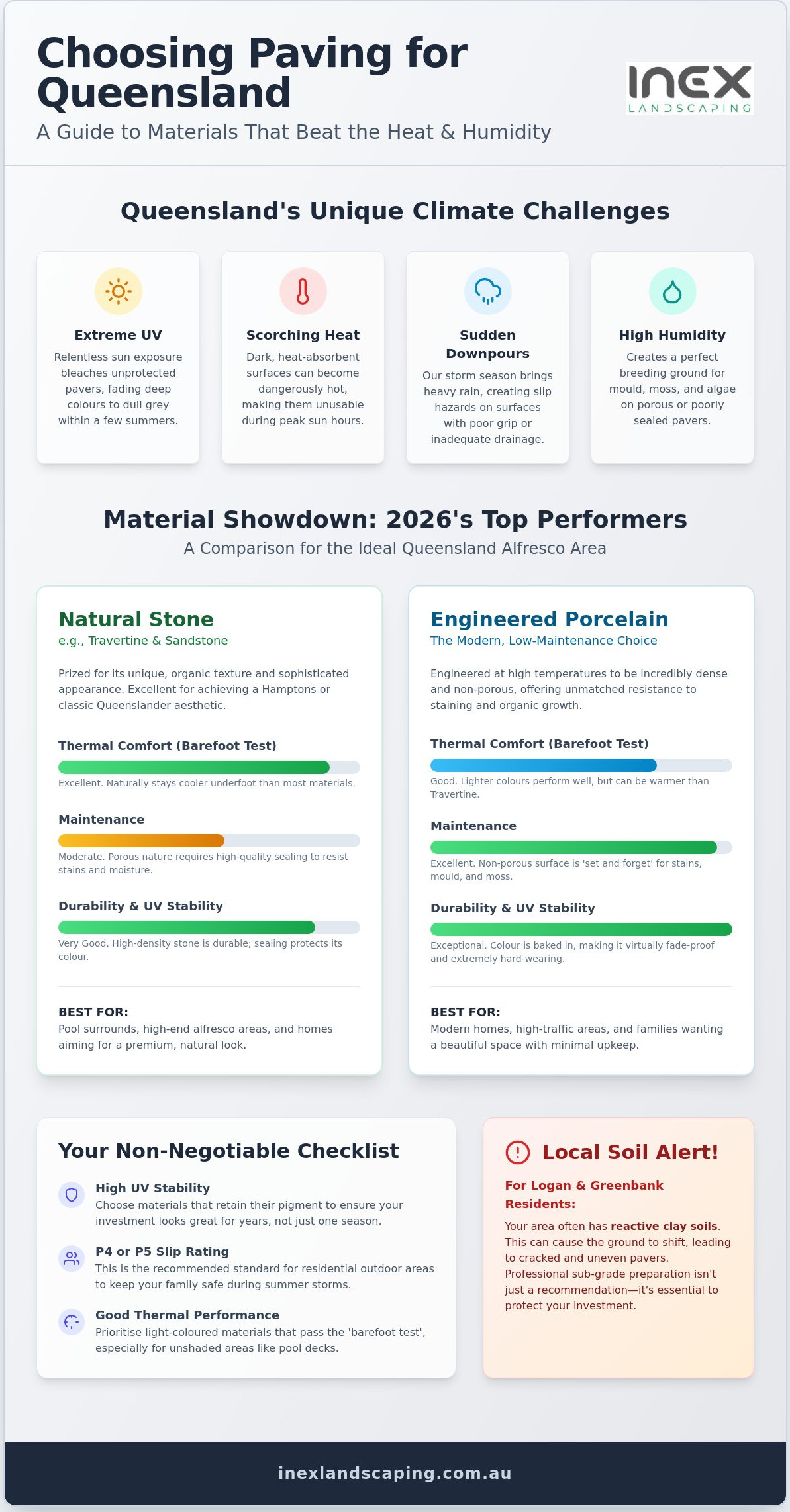
Living in South East Queensland means embracing a lifestyle where the backyard is just as important as the lounge room. However, what works for a patio in Melbourne or Adelaide simply won’t cut it here. The best paving for outdoor areas Queensland residents can invest in must account for our relentless sub-tropical conditions. We face extreme UV levels, high humidity, and sudden, heavy downpours that can turn a beautiful terrace into a slippery hazard in minutes. Choosing the right material isn’t just about the initial look; it’s about how that surface performs under pressure over the next decade.
Our sun is famous for bleaching everything it touches. If you choose a paver without high UV stability, that deep charcoal you loved in the showroom will likely fade to a dull grey within two summers. We focus on materials that retain their pigment, ensuring your investment looks as good in year five as it did on day one. Beyond durability, your choice should facilitate a seamless transition from your kitchen to your alfresco area. This indoor-outdoor flow is a hallmark of local architecture. It requires a paving stone that looks as refined as an internal tile but possesses the structural integrity for the outdoors.
Safety is another non-negotiable factor during our frequent summer afternoon storms. We look for specific P-ratings, which measure slip resistance. For most residential outdoor areas, a P4 or P5 rating is the standard we recommend to keep your family safe when the clouds burst. It’s about finding that sweet spot where the surface feels smooth underfoot but provides enough grip when wet.
The Impact of Humidity and Rainfall
High humidity creates a perfect breeding ground for organic growth. Porous materials act like sponges, soaking up moisture and providing a home for mould and moss. This is particularly troublesome in shaded spots or near garden beds. To prevent this, we always emphasise the importance of high-quality sealing. Proper drainage is also critical. Without a correctly graded sub-base, water pools during the Brisbane storm season, leading to unsightly stains and potential structural issues over time.
Thermal Comfort: The “Barefoot Test”
We often talk about the barefoot test with our clients. If you can’t walk on your pavers at 2:00 PM in January, they aren’t fit for purpose. Light-coloured materials are essential for unshaded pool decks because they reflect solar radiation rather than absorbing it. This same logic applies to the rest of your home’s exterior; for example, you can explore Roof Replacement with light-coloured materials to improve your home’s overall thermal efficiency. While dark concrete might look modern, it can reach temperatures that are painful to touch, whereas natural stones like travertine stay significantly cooler, making them a superior choice for west-facing alfresco areas where the afternoon sun is at its most punishing.
The Best Paving Materials for South East Queensland
Selecting the right material is the foundation of any successful landscaping project. While aesthetics are important, the best paving for outdoor areas Queensland homeowners choose must withstand our unique humidity and intense sun. We generally categorise the top performers into four primary groups: natural stone, porcelain, concrete, and clay. Each offers distinct advantages depending on whether you are surfacing a luxury poolside or a high-traffic driveway.
Natural stone remains a top-tier choice for South East Queensland. Travertine is particularly prized for its sophisticated appearance and its ability to stay cool under the midday sun. Sandstone is another local favourite, offering earthy textures that blend beautifully with native gardens. Both materials provide a high-end finish that significantly boosts property value. However, they are porous by nature. If you choose stone, you must commit to high-quality sealing to protect against the moisture levels we experience during the summer storm season.
Looking toward 2026, porcelain pavers have become a dominant trend for modern homes. These are engineered at extremely high temperatures to be incredibly dense and non-porous. This manufacturing process makes them virtually “set and forget” regarding stains, mould, and moss. For families who want a beautiful alfresco space without the ongoing maintenance of natural stone, porcelain is an excellent investment.
Natural Stone vs. Engineered Porcelain
The choice between stone and porcelain often comes down to your lifestyle. Travertine offers a unique, organic texture that many find more authentic for a Hamptons-style home. It handles the Logan climate well if maintained. Porcelain, on the other hand, is the preferred choice for modern pool surrounds because it is naturally slip-resistant and resistant to salt and chlorine. It doesn’t require regular sealing, making it the ultimate low-maintenance option for busy households.
Concrete and Clay: Durability for High-Traffic Areas
For larger properties in Greenbank or South Maclean, concrete pavers offer incredible versatility and cost-effectiveness. They are engineered to handle significant weight, making them ideal for driveway paving South Maclean projects. Interlocking designs are particularly effective at distributing heavy vehicle loads, which helps prevent the shifting often seen with standard poured concrete slabs.
Clay pavers bring a nostalgic warmth that perfectly complements a traditional Queenslander renovation. They are exceptionally hard-wearing and retain their colour for decades because the pigment is baked directly into the clay. These are fantastic for creating textured garden paths or borders that add character to a landscape. If you’re unsure which material suits your specific site conditions, our team can help you select the best paving solution for your property’s unique layout.
Design Inspiration: Matching Pavers to Local Queensland Styles
Choosing the best paving for outdoor areas Queensland homes feature involves more than just selecting a durable material; it’s about creating a cohesive visual narrative. Your patio shouldn’t feel like an afterthought. Instead, it should act as a natural extension of your internal floor plan. Have you considered how the colour and size of your pavers can completely alter the perceived scale of your property? For homeowners in growing areas like Greenbank, where block sizes vary, the right design choices can make a modest backyard feel like a sprawling retreat. Pairing your paving selections with a well-considered outdoor living area design Queensland plan ensures every element of your backyard works together as a unified, functional space.
Large-format pavers are a standout trend for 2026. By using oversized units, typically 600x600mm or larger, you significantly reduce the number of visible grout lines. This creates a cleaner, more expansive look that tricks the eye into seeing a broader surface. This technique is particularly effective when integrated into a comprehensive backyard renovation Greenbank QLD locals are increasingly opting for to maximise their outdoor living potential. Texture also plays a vital role in defining different “zones.” You might choose a smooth finish for your primary alfresco dining area while transitioning to a more tactile, grip-focused surface around the pool or fire pit to subtly signal a change in the area’s purpose.
The Hamptons and Coastal Aesthetic
The Hamptons look remains incredibly popular across South East Queensland. To achieve this, we recommend a palette of soft greys, crisp whites, and muted creams. Tumbled textures are essential here; they provide a relaxed, lived-in feel that softens the landscape. French Pattern layouts, which use a mix of four different stone sizes, are a fantastic way to add historical charm to a modern pool area. Pairing these light-toned pavers with a lush, green turf border creates a high-contrast, premium finish that epitomises coastal luxury.
Modern QLDer and Contemporary Minimalism
For those renovating a classic Queenslander or building a sleek contemporary home, minimalism is the way forward. Straight-edge porcelain pavers offer a sharp, architectural finish that complements clean building lines. We often see homeowners matching their paving tones to popular Colorbond roofing colours. For example, a light Surfmist-inspired paver can brighten a shaded courtyard, while charcoal borders in a shade like Monument can frame an outdoor dining space with masculine sophistication. This attention to detail ensures your landscaping feels like an intentional part of your home’s overall architecture, much like how The Institute of Curiosity helps people notice and rethink the nuances of their everyday interactions through their engaging magic-based performances and workshops.
Handling Reactive Soils and Drainage in Logan and Greenbank
If you live in the Logan region, you’ve likely heard the term “reactive soil.” This refers to the high concentration of clay that expands when wet and shrinks as it dries. According to AS 2870, many areas in Greenbank and Logan are classified as Class H to H2, meaning the ground is highly reactive. This constant movement is the primary cause of cracked pavers and uneven surfaces. Finding the best paving for outdoor areas Queensland homeowners can rely on requires looking beneath the surface at the engineering of the entire system.
For ground that moves this much, we typically recommend flexible paving systems over rigid ones. A rigid system involves mortaring pavers onto a concrete slab. When the clay soil shifts, the slab cracks, and those cracks transfer directly through your beautiful stone. A flexible system uses a sand-set method over a thick, compacted road-base. This allows the individual units to “breathe” and settle slightly without compromising the structural integrity of the entire patio. Managing these soil shifts often requires a multi-faceted approach, which is why we frequently work alongside retaining wall builders Greenbank QLD residents trust to stabilise slopes before the first paver is even laid.
Sub-grade Preparation for Longevity
The secret to a flat patio in clay-heavy areas like Bahrs Scrub is the depth of the base. We don’t just scrape the surface; we excavate deep enough to install a substantial layer of road-base. We also utilise geo-textile fabrics between the raw soil and the base material. This fabric acts as a barrier that prevents the heavy clay from migrating upwards and contaminating your clean drainage gravel. Professional compaction is the most important step here. Without it, the weight of the pavers and garden furniture will eventually cause the ground to sink in patches.
Effective Drainage Solutions
Water is the enemy of reactive soil. If water pools against your pavers, the clay underneath will swell unevenly. We ensure every project has a minimum fall of 1:100, meaning the surface slopes away from your home’s foundations. For the heavy downpours common in South East Queensland, standard sloping often isn’t enough. We integrate strip drains and catch pits into the design to capture and redirect high volumes of runoff quickly. If you’re concerned about how the local soil might affect your project, contact our paving specialists for a site assessment to ensure your outdoor area is built to last.
Long-Term Care: Maintaining Your Outdoor Paving in the Sunshine State
Once you’ve selected and installed the best paving for outdoor areas Queensland weather can throw at you, the focus shifts to preservation. Our local climate is beautiful, but it’s also incredibly harsh on building materials. Between the bleaching UV rays and the torrential summer downpours, your pavers face constant environmental stress. Proper maintenance isn’t just about keeping things tidy; it’s about protecting the structural integrity and aesthetic value of your home for the next decade.
A common issue homeowners face in South East Queensland is efflorescence. These are the white, salty deposits that sometimes appear on the surface of new concrete or clay pavers. It occurs when moisture evaporates and leaves mineral salts behind. While it can be frustrating, it’s usually a temporary phase. You can treat it with a specialised efflorescence cleaner, but avoid using harsh acids that can etch the surface of your stone. Taking the time to understand these natural processes helps you maintain that “just installed” look for much longer.
Ultimately, the level of effort required to keep your patio looking pristine depends on how it was built. Investing in a professional paving installation in Greenbank QLD is the most effective way to reduce long-term maintenance. When the drainage is calculated correctly and the sub-grade is stable, you won’t have to deal with the constant headaches of pooling water, sinking units, or excessive weed growth that plague poorly executed projects.
Sealing and Protecting Your Investment
For the 2026 season, we recommend penetrating sealers over topical coatings for almost every Queensland application. Topical sealers act like a plastic film on top of the paver, which can peel or trap moisture in our high humidity. Penetrating sealers soak into the material, protecting it from within while allowing the stone to breathe. For high-traffic BBQ areas or pool surrounds, plan to re-apply your sealer every three to five years. This prevents oil, chlorine, and leaf tannins from permanently staining the surface.
Routine Cleaning and Weed Management
Keep your cleaning routine simple to avoid damaging your pavers. While pressure washing is a great tool, don’t use a narrow, high-pressure nozzle too close to the joints. This can blast away the joint sand, leading to unstable pavers and inviting weeds to take root. Instead, use a fan-spray setting and consider using polymeric sand during the initial build or a refresh. This specialised sand hardens to create a weed-resistant barrier. For driveway oil spills, act quickly with an absorbent powder to pull the liquid out before it settles into the pores of the concrete.
Transforming Your Queensland Backyard with Confidence
Creating an outdoor space that stands the test of time in the Sunshine State requires more than just picking a pretty tile. It involves engineering a system that survives reactive clay and the punishing UV index. By choosing materials like travertine or porcelain and ensuring your drainage is precisely graded, you’re investing in a lifestyle upgrade that adds genuine property value. Finding the best paving for outdoor areas Queensland families can enjoy year-round is much simpler when you have a plan that accounts for both aesthetics and sub-tropical durability. To take the next step, explore how a complete outdoor living area design Queensland approach can bring your paving, landscaping, and entertaining zones together into one cohesive vision.
With over 10 years of experience navigating the specific soil conditions of South East Queensland, we understand the complexities of building in areas like Logan and Greenbank. Our team provides a complete end-to-end service, from meticulous site preparation to the final protective seal, all while adhering to local council requirements. If you’re ready to elevate your property, Get a Professional Paving Quote for Your Greenbank Home today. Your dream backyard is within reach.
Frequently Asked Questions
What is the best paver for a pool area in Queensland?
Travertine and high-grip porcelain are the top choices for local pool surrounds due to their durability and safety ratings. You should look for a material with at least a P4 or P5 slip resistance rating to ensure the surface remains safe during our heavy summer downpours. Travertine is often considered the best paving for outdoor areas Queensland families choose for pools because its natural density helps it stay cool while resisting damage from salt and chlorine.
How much does paving installation cost per square metre in Logan?
The cost of your paving project depends on several factors, including your choice of material, the complexity of the site, and the level of sub-grade preparation required. Natural stone generally involves a higher material investment than concrete pavers, and sites with difficult access or heavy reactive clay may require more extensive excavation. We recommend a professional site assessment to get an accurate quote tailored to your specific backyard layout and soil conditions.
Do I need a council permit for paving in Greenbank?
Most residential paving projects in Greenbank don’t require a formal permit if they fall under standard landscaping and don’t alter the property’s primary drainage patterns. However, you must ensure your design doesn’t block overland flow or exceed the site coverage limits set by Logan City Council. If you’re planning a massive transformation that involves significant earthworks or retaining walls, it’s wise to check for registered easements on your property first.
Which pavers stay the coolest in the direct summer sun?
Light-coloured natural stones like travertine, limestone, and light sandstone are the most effective at resisting heat. These materials have lower thermal mass than darker concrete or brick, meaning they reflect solar radiation rather than soaking it up. If your alfresco area faces west and receives the full brunt of the afternoon sun, choosing a “cool-touch” light-toned stone will make the space much more comfortable for bare feet.
How do I stop my pavers from sinking in reactive clay soil?
The key to a stable surface in reactive clay is a deep, well-compacted foundation of road-base. We use geo-textile fabrics to create a barrier between the raw clay and your paving base, which prevents the soil from “swallowing” your drainage gravel over time. This flexible installation method allows the pavers to settle naturally with the ground’s movement without the structural cracking you’d see in a rigid concrete slab.
Is porcelain better than natural stone for QLD outdoor areas?
Porcelain is superior for homeowners who want a low-maintenance, stain-resistant finish that never needs sealing. It’s incredibly dense and won’t host mould or moss, even in high humidity. However, natural stone is often preferred for its organic beauty and its ability to stay cooler under the intense Queensland sun. Both are excellent options, so your choice should depend on whether you prioritise ease of cleaning or thermal comfort.
How long does professional paving installation typically take?
A standard patio or pool surround project usually takes between three to seven working days from start to finish. This timeline includes the essential stages of excavation, base compaction, laying the pavers, and applying the final jointing sand. Larger projects or those requiring significant site levelling and retaining work may take longer, especially if we’re working around the unpredictable South East Queensland storm season.
Can I pave directly over an existing concrete slab?
Yes, you can pave over concrete if the existing slab is structurally sound and has a correct drainage slope. We typically use a thin-set mortar or a specialised adhesive to bond the pavers directly to the concrete. It’s critical to ensure that the added height of the pavers doesn’t block your home’s weep holes or create a step-up that could become a trip hazard at your back door.