
Choosing Colorbond fencing Greenbank homeowners can feel confident about starts with the property, not just a colour sample. The fence needs to suit the home and garden, follow the boundary and work with the practical conditions of the block.
A slope, narrow access or established garden bed can affect the fence layout. Colour and screening also shape how the fence looks from inside the yard and beside neighbouring boundaries. Thinking through these details early helps you make decisions that fit your site.
This guide covers what to consider when planning a fence in Greenbank, how to compare design priorities and what to prepare before installation. You’ll find practical steps for planning placement, colour and screening, from the first sketch through to the finished boundary. INEX Landscaping is based in Greenbank and provides fencing alongside landscaping and outdoor construction, so the fence can be considered in relation to the wider outdoor layout.
Key Takeaways
- Match the fence’s purpose and layout to your boundaries, outdoor use and site conditions.
- Compare colours and fence lines with your home’s exterior, paving, planting and neighbouring boundaries.
- Weigh privacy, visual character, maintenance and garden integration for each boundary section.
- For Colorbond fencing Greenbank, define your priorities, sketch the layout and note access, ground levels and existing features.
- Bring your design choices and relevant local requirements together when planning fencing with INEX Landscaping.
Why Greenbank homeowners consider COLORBOND® fencing for their property
Privacy, a clearly defined boundary and a tidy appearance are common reasons to plan a residential fence. But a useful boundary needs to suit how you use the yard, not just look appealing in a product image. A colour sample won’t show how the fence meets a garden bed, follows a change in ground level or sits beside an outdoor living area.
COLORBOND® fencing is a steel fencing option used to define and enclose residential boundaries. Whether it suits your Greenbank property depends on the purpose of the fence, the site layout and the appearance you want.
Start with the property itself. Greenbank homes and blocks vary, so consider each boundary in context. For a general geographical overview, the Greenbank, Queensland Wikipedia page offers local context. Your own site provides the details that shape a practical fence plan.
What homeowners want their Greenbank fence to do
List the job you need each section of fence to do. You might want screening beside an outdoor sitting area, a clear division between adjoining properties or a neat edge along the street. Consider who uses each part of the property and what happens there, such as children playing, garden maintenance or moving between outdoor areas.
Next, check how the proposed line relates to nearby garden beds, paths and outdoor spaces. A fence can affect planting room and access around the yard. Since each boundary may have a different purpose, note the priority for each section before deciding on an overall design.
Where COLORBOND® fencing fits into an outdoor plan
Plan the fence line alongside other outdoor features. For example, consider how it will meet paving, lawn edges and planting, rather than treating each feature as a separate job. This helps you spot awkward transitions and gaps in the wider layout before work begins.
Look beyond the fence face. Note changes in ground level, existing garden features and adjoining structures that may affect the line. If you’re planning several outdoor improvements, explore how they fit together in the Greenbank landscaping services guide. INEX Landscaping provides fencing alongside landscaping and outdoor construction work, so the surrounding space can be considered as part of the plan.
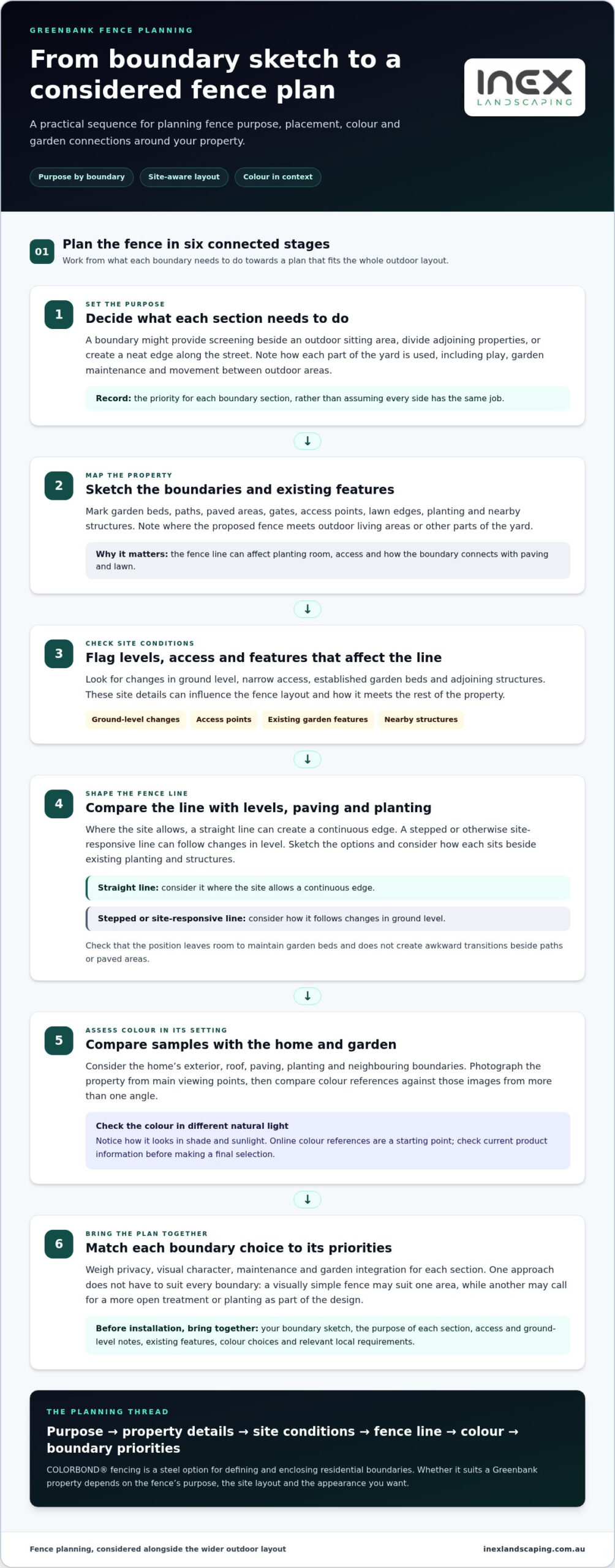
Before choosing a colour, sketch the boundaries and write down the purpose of each one. This gives layout and colour decisions a practical foundation and helps you assess them against the home, garden and site.
How colour, fence lines and garden features shape a Greenbank design
A fence colour may look different beside a roof, rendered wall or garden than it does on a small sample. Assess it alongside the home’s exterior, roof, paving, planting and neighbouring boundaries. The aim isn’t to match every surface, but to choose a colour that feels deliberate from the yard and the street.
Choosing a fence colour that suits the home
Start with the largest colours and materials already on the property. A fence beside a light exterior and pale paving will create a different impression from one set against dark roofing and dense planting. Consider nearby homes too, particularly where the fence will be prominent along a shared boundary. Judge colour in the setting where it will be seen.
Compare reference images or samples against the property in different natural light, and view them from more than one angle. The COLORBOND® Studio is a useful place to explore colour ideas. Treat online colours as a starting point, then check current product information before making a final selection.
Planning the fence around planting, paving and levels
Before settling on the fence line, mark garden beds, paved areas, gates, access points and changes in ground level. A line too close to a garden bed may leave little room for planting or maintenance. Beside paving, the fence position can affect the usable space and the way its edge looks. Considering these relationships early helps the fence sit naturally within the yard.
Pay particular attention to where the fence meets paving. Think about how the boundary will sit beside the paved surface and whether the line affects a path or outdoor area. The Greenbank paving installation guide can help you plan paving as part of the same outdoor layout.
Ground levels also affect the finished appearance. Where the site allows, a straight line can create a continuous edge. A stepped or otherwise site-responsive line can follow changes in level. Sketch the options and compare how each would look beside existing structures and planting.
- Photograph the home, roof, paving and boundary from the main viewing points.
- Compare colour references with those images, noting how they look in shade and sunlight.
- Sketch the proposed fence line and mark garden beds, paved areas, access and changes in level.
This turns a colour preference into a considered design direction. INEX Landscaping provides fencing and adjacent outdoor work, helping you plan how the boundary fits with the rest of the property. Explore INEX’s Greenbank outdoor services as you shape the next steps.
Colorbond fencing compared with other boundary priorities
Compare what each boundary needs to achieve instead of looking for one approach that suits every side of the block. A visually simple fence may suit one area, while another may call for a more open boundary treatment or planting as part of the design. Each option has a different appearance and needs to be considered in relation to the site.
The right boundary choice depends on your site needs and design priorities. Use the comparison below to clarify what matters before choosing a direction. It focuses on practical questions, rather than promises about how a particular material will perform.
| Priority | Questions to consider | How it shapes the choice |
|---|---|---|
| Privacy preference | Do you want a more enclosed visual boundary, or do you prefer a more open feel? | Compare the level of screening you want with how the boundary will look from inside and outside the property. |
| Visual character | Should the fence recede into the background, or be a prominent design feature? | Consider a COLORBOND® fence alongside other fence treatments and the home’s existing style. |
| Maintenance expectations | How much ongoing attention are you comfortable giving the fence and adjacent garden? | Consider the chosen material and whether planting near the boundary will add garden tasks. |
| Garden relationship | Will the fence sit behind planting, meet a paved area or define a clear edge? | Plan how the boundary works with garden beds, paths and any retaining structures. |
Which fencing priorities matter most for your property?
Rank your preferences before comparing options. Screening might matter most beside an outdoor living area, while a tidy appearance could be the priority at the front. Then separate those preferences from site constraints such as narrow access, uneven ground or established garden features. Record both your ideal result and the practical conditions that could shape the layout.
For Colorbond fencing Greenbank homeowners can use a simple test: write down the purpose of each boundary, then note the visual and practical factors that could affect its placement. This gives you a clear basis for comparing options without assuming one solution suits every side of the property.
How to compare the finished look with nearby outdoor features
Assess the boundary as part of the complete outdoor view. A simple fence may provide a quieter backdrop where planting, paving or other garden features already draw the eye. Where a retaining structure meets the fence, consider how their lines and materials will sit together. The Greenbank retaining wall guide can help you plan this adjoining feature as part of the same layout.
INEX Landscaping plans fencing alongside landscaping and outdoor construction. If you’re combining boundary choices with other outdoor work, explore INEX’s fencing and landscaping work.
Planning a Colorbond fence installation in Greenbank
A clear plan helps turn a boundary idea into a project that fits the property. Before organising the work, define what the fence needs to do, map the intended line and note site conditions that could shape the installation. For Colorbond fencing Greenbank homeowners should consider access, existing outdoor features and the proposed boundary together.
Local approval requirements can depend on the specific property and the proposed work. Before relying on any rule about approvals, boundary location or adjoining owners, check current guidance from Logan City Council and the relevant Queensland Government information. This keeps your planning grounded in official, up-to-date requirements.
What to consider before work begins
Identify the intended fence line and the areas it needs to accommodate. Walk the proposed route and note where it meets the house, garden, driveway or neighbouring features. If the boundary’s position is uncertain, don’t treat a sketch or existing fence as definitive. Use verified official information relevant to your property to guide questions about boundary responsibilities and approval requirements.
Record practical details that may affect the work:
- Existing planting, garden beds and trees near the proposed line.
- Paving, paths, driveways and access points that need to remain usable.
- Changes in ground level, retaining structures and other adjoining features.
- Available access along the boundary for carrying out the work.
These observations bring site conditions into the planning conversation early. A narrow side passage or a garden bed close to the proposed line, for example, may affect how the work is organised. A fence that meets a retaining structure should be considered in relation to both features, rather than as an isolated boundary detail.
How INEX Landscaping approaches a fencing project
INEX Landscaping is based in Greenbank and provides fencing alongside landscaping and outdoor construction work across South East Queensland. Planning the fence in relation to the wider outdoor layout helps connect the boundary with garden areas, paving, turf or retaining work. It also gives you a chance to consider how adjoining features meet and how the work fits together.
A practical planning sequence is straightforward:
- Define the purpose of each boundary section and the areas the project must accommodate.
- Set out the proposed fence line in relation to the house, access points and neighbouring features.
- Assess the site, noting levels, landscaping, paving, retaining structures and access conditions.
- Keep current official guidance on local requirements and boundary matters in view as you organise the work.
With these details gathered, you’ll have a clear brief for discussing how the fence relates to the rest of your outdoor space. Discuss your Greenbank fencing project with INEX Landscaping.
Bring your Greenbank Colorbond fencing plan together with INEX
A considered fence plan brings together the boundary’s purpose, the look you want and the practical shape of your property. Before moving ahead, be ready to describe what each section needs to do, where the proposed line will run and how it relates to existing outdoor features. Keep relevant local requirements in view, using current official guidance for your property and proposed work.
A useful brief can be simple: note where you want screening, which areas need access, how the fence should sit beside the home and whether ground levels or adjoining structures affect the layout. For Colorbond fencing Greenbank homeowners, this property-specific thinking turns an initial idea into a practical project discussion.
Make the fence part of a cohesive outdoor transformation
A boundary is one part of the yard’s overall design. If you’re refreshing an outdoor area, consider how the fence will meet planting, turf, paving or retaining structures, and which features need to be planned together. One project might combine a new fence line with changes to the lawn, while another may focus on the boundary alone. Choose the scope that fits your property and priorities.
If you’re considering artificial grass as part of a yard refresh, the artificial grass installation guide for Greenbank offers another perspective on planning an outdoor surface alongside the rest of the space. INEX Landscaping provides fencing as part of its broader landscaping and outdoor construction work, so you can discuss how the fence relates to nearby features.
Take the next step with a local Greenbank team
INEX Landscaping is based in Greenbank and works across South East Queensland. Start with your property, priorities and preferred layout. Share the boundary’s intended purpose, note features such as paving or planting, and describe the outdoor result you’re aiming for. These details give the project discussion a practical starting point.
Keep your proposed fence line and relevant local requirements in view as you plan. For boundary details or approval questions, refer to current official guidance rather than relying on assumptions. With the site context and your preferred direction outlined, you’ll be ready to discuss how fencing can fit the wider outdoor plan.
Ready to talk through your property and plans? Talk to INEX about fencing in Greenbank.
Turn your fence ideas into a considered plan
A well-planned boundary can help create a more settled, functional outdoor space. Before taking the next step, jot down what you want the fence to achieve and any property details that could shape the work. Notes about the areas you use most, the look you prefer and features beside the boundary will make the first project discussion clearer.
With Colorbond fencing Greenbank homeowners can consider the bigger picture, rather than treating the fence as a standalone choice. You don’t need every detail finalised before discussing what may suit your property. Start with your priorities and use them to guide the plan.
INEX Landscaping takes a professional, customer-focused approach, with an emphasis on consistent quality and strong client relationships. Ready to discuss your property and the outdoor result you have in mind? Talk with INEX about your fencing project.
Frequently Asked Questions
Is Colorbond fencing suitable for a Greenbank home?
Colorbond fencing may suit a Greenbank home if its appearance and purpose fit the property and layout. A boundary beside a courtyard, for example, may have different screening priorities from a front boundary defining the street-facing yard. Consider how the fence relates to neighbouring structures, access and garden use. Suitability depends on these site-specific details, not just the fence’s appearance.
How do I choose a Colorbond fence colour for my house?
Compare colour options with the most visible parts of your home, such as the exterior walls, roof and paving. Look at samples or reference images beside the house and in the light where the fence will be seen. A colour that looks balanced on a screen may feel different beside your garden or neighbouring boundary. Check current product information before making your final choice.
Do I need council approval for a fence in Greenbank?
A domestic fence up to two metres high generally doesn’t require building approval from Logan City Council, but some situations have different requirements. Approval may be needed for a fence over two metres, one on a retaining wall where combined height matters, a corner-block fence affecting sightlines, or a property in a relevant overlay. Pool barriers have separate safety requirements. Check current Logan City Council and Queensland guidance for your proposed work.
Can Colorbond fencing be installed on a sloping Greenbank block?
A sloping block can be considered for Colorbond fencing, but the ground profile needs to inform the layout. Note where the slope starts, how sharply the level changes and where paths, retaining structures or adjoining features meet the proposed line. These details help shape a site-responsive plan and clarify what needs discussion before work is organised. Consider the finished fence line in relation to the property’s levels and boundaries.
How do I plan a Colorbond fence around existing landscaping?
Map established features near the boundary before deciding where the fence should run. Mark garden beds, paving, trees, paths and areas that need ongoing access, then note which features you want to retain or change. A narrow planting strip may need room for maintenance, while a paved path needs a clear connection to the rest of the yard. Sharing these details early makes layout planning more practical.
What should I prepare before arranging a fencing project in Greenbank?
Prepare a short brief describing the boundary’s purpose, your preferred look and any site features that could affect the layout. Photos, a simple sketch and approximate measurements can help explain the property and your priorities. INEX Landscaping is based in Greenbank and serves Greenbank, Yarrabilba, Parkridge, Marsden, Bahrs Scrub and South Maclean. Include questions about the proposed boundary or local requirements in your project discussion.