
The hardiest grass in Australia will still struggle to survive if it’s rolled directly onto unconditioned, reactive clay. Choosing Sir Walter buffalo turf Bahrs Scrub homeowners consistently trust is an outstanding decision for your property, but your lawn’s long-term health depends on meticulous site preparation just as much as grass variety.
Between sloping residential allotments, rocky ground, and the deep shade cast by boundary fences and neighbouring double-storey homes, establishing a soft green lawn in our local estates can feel like an uphill battle. You want a durable outdoor area that holds up to active family life and hot Logan summers, without the frustration of turf failing to strike root or dying off in patches.
Discover why Sir Walter buffalo turf thrives in Bahrs Scrub soils and how proper installation guarantees a lush lawn that stays vibrant all year. In this guide, we’ll walk you through essential clay soil conditioning, shade management, and the practical earthworks required to give your lawn an enduring foundation.
Key Takeaways
- Understand why Sir Walter’s exceptional shade tolerance and self-repairing runners make it ideal for narrow estate blocks and tall boundary fences.
- Discover why proper clay preparation with gypsum and sandy loam underlay ensures your Sir Walter buffalo turf Bahrs Scrub lawn establishes deep, resilient roots.
- Compare buffalo with couch and zoysia varieties across sunlight demands, mowing upkeep, and wear resistance to suit your family’s lifestyle.
- Unpack the professional installation sequence, from prompt same-day rollout to seamless joint alignment that protects fresh roots from drying out.
- Follow essential early watering schedules and initial mowing heights designed to lock in moisture and promote deep anchorage.
Why Sir Walter Buffalo Turf Suits Bahrs Scrub Properties
Modern residential developments in Bahrs Scrub feature distinct microclimates. Contemporary estates like Brookhaven combine compact boundary setbacks with prominent two-storey designs. These architectural layouts cast long shadows across side passages and backyards while trapping subtropical heat during summer. For long-term performance across these conditions, Australian-bred Stenotaphrum secundatum buffalo grass remains the premier choice.
Sir Walter DNA Certified buffalo is a proven warm-season turf engineered specifically for Australia’s harsh climatic swings. Its vigorous, above-ground runners (stolons) weave together to create a dense, interlocking mat. This dense ground cover crowds out opportunistic broadleaf weeds like bindii and clover before they take hold, dramatically reducing your reliance on chemical treatments. Choosing Sir Walter buffalo turf Bahrs Scrub homeowners rely on provides a living carpet that stays verdant despite challenging local terrain.
Exceptional Shade Tolerance for Suburban Blocks
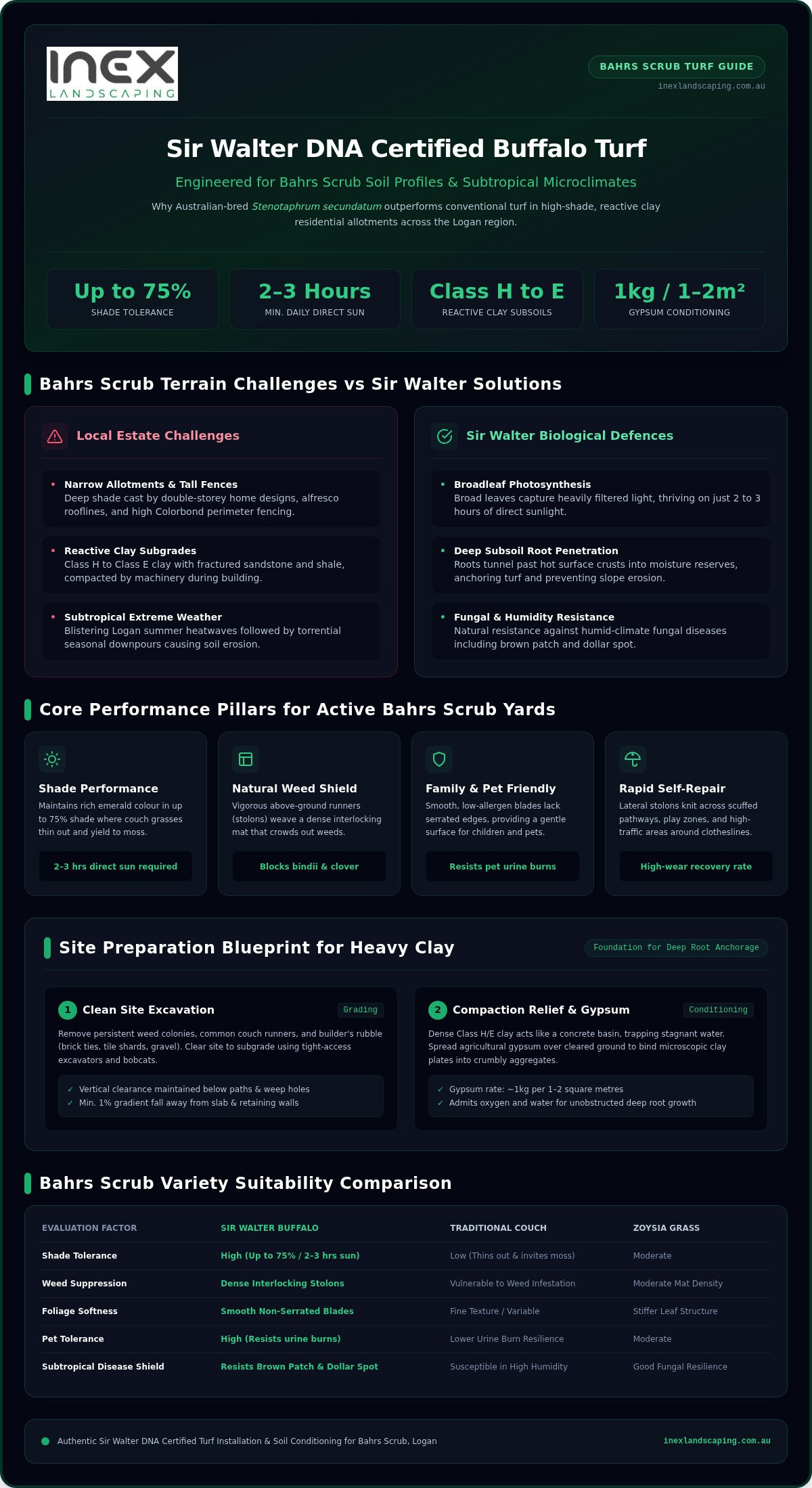
Narrow boundary clearances between neighbouring homes frequently restrict natural daylight. While traditional couch grasses thin out and surrender to moss when deprived of full sun, Sir Walter thrives on just two to three hours of direct daily sunlight. It comfortably tolerates up to 75 percent shade from high Colorbond fencing, alfresco rooflines, and mature perimeter trees. The broad leaf blades maximise photosynthesis, retaining a deep emerald colour throughout heavily filtered light zones.
Superior Drought and Heat Recovery in Logan
Logan summers bring intense heat waves punctuated by torrential subtropical downpours. Sir Walter establishes a deep, extensive root system that tunnels past hot surface crusts to tap into subsoil moisture reserves during dry spells. When heavy seasonal storms roll through, this robust root architecture prevents soil erosion on sloped Bahrs Scrub allotments. Unlike cool-climate varieties that struggle with local humidity, Sir Walter exhibits exceptional natural resistance to fungal diseases such as brown patch and dollar spot.
Family and Pet Durability for Active Backyards
Backyards should be lived in, not just looked at. Sir Walter delivers the ideal blend of softness and structural resilience for active families:
- Low-allergen soft foliage: Smooth, broad blades lack the microscopic serrated edges found in older buffalo varieties, making it gentle on bare feet and young children.
- Rapid self-repair: Tight lateral stolons quickly knit across scuffed pathways and high-traffic play areas around swing sets or clotheslines.
- High pet tolerance: The dense thatch layer handles regular dog traffic with minimal thinning and displays superior tolerance to pet urine burns compared to fine-bladed turf varieties.
Investing in genuine Sir Walter buffalo turf Bahrs Scrub yards need ensures your outdoor area remains hard-wearing, visually striking, and comfortable right through the blistering summer months.
Preparing Bahrs Scrub Soil Profiles for New Turf
Laying turf directly onto unprepared building ground is the primary reason new lawns fail. Across Bahrs Scrub developments, building allotments sit on Class H to Class E reactive clay mixed with fractured sandstone and shale. Compacted by heavy construction machinery during home builds, this dense subgrade acts like a concrete basin, trapping stagnant water during wet spells and suffocating young turf roots. Establishing healthy Sir Walter buffalo turf Bahrs Scrub yards require starts deep below the surface.
Step 1: Clearing Weeds, Old Grass, and Debris
Clean site excavation forms the first critical barrier against weed invasion and settlement hollows. Our process removes surface contaminants thoroughly:
- Strip away persistent weed colonies, common couch runners, and buried builder’s rubble like leftover brick ties, tile shards, and gravel.
- Use tight-access excavators and bobcats to clear the site to an even subgrade level, leaving ample vertical clearance below paths and weep holes.
- Fall the subgrade away from concrete house slabs and retaining walls at a minimum one-percent gradient to stop dangerous water pooling against the footings.
Step 2: Relieving Compaction and Conditioning Heavy Clay
Tightly packed clay subsoils stop delicate roots from moving deeper into the profile. To fix this, spread agricultural gypsum at a rate of roughly one kilogram per one to two square metres over the cleared ground. Gypsum flocculates sticky clay, binding microscopic clay plates into crumbly aggregates that admit oxygen and water. Tilling this down 100 millimetres into the subbase breaks the hardpan, allowing root networks to establish deep drought tolerance in accordance with Your Home outdoor watering guidelines. On sloping blocks, pairing this excavation with engineered timber or concrete sleeper retaining walls creates usable, level plateaus that prevent subsoil washouts.
Step 3: Spreading and Screeding Premium Turf Underlay
Once the subbase is conditioned, import 100mm to 150mm of certified turf underlay, ideally an 80/20 mix of washed river sand and rich organic loam. Sand promotes rapid vertical drainage through heavy Logan downpours, while the organic matter retains essential nutrients and beneficial soil biology. Screed the bed evenly using an aluminium straight edge to eliminate depressions where scalping could occur during mowing. A light roll with a water-filled drum roller settles the bed, creating a firm, level platform ready for the instantaneous rollout of your Sir Walter buffalo turf. For complex, undulating residential sites, coordinating your project with professional lawn and turf installation ensures all earthworks, drainage falls, and soil underlays meet structural standards before laying a single roll.
Comparing Sir Walter with Common Queensland Turf Varieties
Selecting turf for your yard requires balancing sunlight levels, weekend maintenance commitments, and overall lifecycle value. While several warm-season turf species flourish across South East Queensland, their performance diverges sharply under standard suburban fence lines and intense summer growth cycles. Understanding these physiological distinctions helps determine whether Sir Walter buffalo turf Bahrs Scrub yards demand is the practical choice over alternative turf options.
Sir Walter Buffalo vs Nullarbor Couch
Nullarbor couch represents an economical upfront choice, but it requires full sun for at least six to seven hours daily. Under the narrow fence setbacks common in modern estates, couch quickly thins, develops bare dirt tracks, and welcomes weed colonies. Couch also produces aggressive underground rhizomes that invade garden beds and paved pathways, requiring constant edging. In contrast, Sir Walter grows upright stolons that stay above ground, making them simple to trim back from garden edging. While couch needs weekly mowing during summer to manage rampant growth, Sir Walter’s moderate vertical growth cuts your summer mowing schedule substantially.
Sir Walter Buffalo vs Empire Zoysia
Empire Zoysia is known for its neat, carpet-like appearance and low mowing requirements. However, zoysia establishes slowly compared to broadleaf buffalo. If heavy pet traffic or active children damage a zoysia lawn, recovery can take months due to its sluggish lateral growth habit. Sir Walter roots down quickly following installation and repairs scuffed patches rapidly throughout warm weather. Both varieties handle heat admirably, yet Sir Walter retains a richer winter colour across Logan when soil temperatures dip.
Weed Control and Chemical Tolerances
Maintaining a pristine turf canopy involves different management practices depending on your grass species:
- Natural suppression: Sir Walter forms an interwoven surface mat that blocks sunlight from reaching buried weed seeds, naturally choking out common invaders like crowsfoot and summer grass.
- Chemical precautions: Buffalo turf is sensitive to selective broadleaf herbicides containing dicamba, which will stunt or kill the broadleaf blade. Always select weed controls specifically registered as buffalo-safe, utilizing formulations based on bromoxynil or MCPA.
- Long-term soil health: Proper nutrient uptake aligns with Queensland Government soil management guidelines, ensuring balanced fertilisation keeps the sward dense enough to outcompete seasonal weeds without excessive chemical intervention.
While fine couches carry a lower initial purchase price, the ongoing investment in fertiliser, selective spraying, and frequent mowing makes genuine Sir Walter buffalo turf the more economical, low-stress investment over the lifespan of your property.
Professional Turf Installation: From Farm Fresh Rolls to Finished Yard
Timing determines whether fresh turf thrives or fails. In South East Queensland’s warm climate, harvested turf stacked tightly on pallets begins to generate internal heat almost immediately. If left bundled for more than 24 hours, the internal rolls can overheat, causing leaf scald and root death before touching the ground. When your order arrives from regional turf farms, every roll must be unrolled and laid across the prepared screeded underlay on the day of delivery.
Precision Laying and Edge Contouring
Precision alignment prevents seams from drying out and creates an instantly uniform surface:
- Staggered joints: Lay rolls in a classic brickwork pattern across your lawn area. Offsetting butt joints stops stormwater runoff from opening up continuous erosion ruts between rolls.
- Tight seams: Butt the edges firmly together without overlapping or pulling the turf, which stretches and weakens the root matrix.
- Clean contours: Use a purpose-designed turf knife or sharpened spade to trim curves around paving, garden borders, and fencing. Always cut from the underside to keep root slabs intact.
Sloped Land and Drainage Considerations
Undulating blocks require specialised handling to maintain surface integrity. On steep batters, lay turf rolls across the face of the slope rather than down it, securing individual slabs with biodegradable turf pegs to stop shifting during establishment. Ensure the finished turf level sits flush with adjoining paving or concrete paths, allowing mower wheels to glide across edges without scalping the turf crown. Where sloped turf zones border structural retaining walls, integrated subsoil agricultural drains collect subsurface runoff, preventing waterlogging behind the wall.
Initial Rolling and Deep Saturation
Once the final slab is placed, roll the entire lawn using a water-filled lawn roller. This mechanical pass presses the turf root layer directly into the imported underlay, eliminating subterranean air pockets that dry out root hairs. Follow rolling with deep, immediate watering until moisture penetrates at least 50 millimetres into the underlying loam. Pay close attention to outer edges along concrete drives and metal fencing, which absorb heat and dry out faster than internal turf runs.
Handling intensive excavation, heavy soil conditioning, and rapid same-day laying requires proper machinery and experienced hands. Rather than struggling with hot pallets and wheelbarrows yourself, contact INEX Landscaping for complete turf installation to ensure your Sir Walter buffalo turf Bahrs Scrub project is completed with absolute precision from start to finish.
Post-Laying Maintenance and Ongoing Lawn Care in Bahrs Scrub
The first month after installation determines your lawn’s long-term resilience. Establishing the Sir Walter buffalo turf Bahrs Scrub properties require consistent moisture, controlled mowing heights, and balanced seasonal nutrition to develop deep root anchorage before peak summer heat sets in.
The Crucial First 28 Days: Watering Protocols
Freshly laid turf relies entirely on deliberate surface watering until subterranean root hairs penetrate the imported underlay. During the initial fortnight, water your lawn two to three times daily for short intervals, ensuring the root mat and topsoil stay moist without creating standing water. By weeks three and four, scale back frequency to once every two days while running sprinklers longer. This transition encourages root tips to drive deeper into the conditioned subsoil seeking moisture. Before reducing watering further, test establishment by gently tugging a slab corner; firm resistance confirms root networks have anchored securely to the bed.
First Mowing and Blade Height Rules
Plan your first mowing session roughly three to four weeks after installation, once the turf cannot be pulled up by hand. Keep these operational rules in mind:
- Sharp blades only: Ensure mower blades are clean and sharp. Blunt blades shred wide buffalo leaves, creating ragged, discoloured tips that invite fungal spores.
- The one-third rule: Never trim more than one-third of the total leaf length in a single pass. Cutting too low shocks immature root zones and stunts lateral growth.
- Adjust for shade: In open, sunny areas, keep cutting heights between 35mm and 50mm. Across shaded fence lines and building setbacks, raise the mower deck to 50mm to 65mm to preserve photosynthetic leaf area.
Feed your established lawn with a slow-release, buffalo-formulated granular fertiliser in early spring, early summer, and mid-autumn. Applying balanced nutrients in autumn strengthens cell walls ahead of cooler months, while spring feeding accelerates leaf recovery.
Partnering with INEX Landscaping for Complete Outdoor Transformations
Undulating Bahrs Scrub blocks frequently require integrated structural solutions to create functional backyards. Combining fresh turf laying with timber or concrete sleeper retaining walls, boundary drainage, and paved entertaining zones prevents slope washouts and frames your lawn cleanly. INEX Landscaping coordinates end-to-end site preparation, tight-access excavation, and turf laying across Logan. Our team manages reactive clay conditioning, soil screeding, and precision alignment, ensuring your Sir Walter buffalo turf Bahrs Scrub project rests on an unshakeable foundation built to last.
Build a Resilient Lawn on Your Bahrs Scrub Property
Achieving a lush, durable lawn across Logan’s newer residential estates comes down to matching the right grass variety with deliberate ground preparation. Sir Walter provides the shade tolerance and vigorous self-repairing habit needed to handle narrow fence lines and energetic family life. Pairing this proven turf with gypsum soil conditioning and a premium sandy loam underlay gives your grass the strong root foundation it needs to thrive year-round.
Based nearby in Greenbank, INEX Landscaping delivers complete turnkey capability across Bahrs Scrub. Our experienced team handles the heavy lifting, uniting precision excavation, underlay spreading, and turf laying with structural retaining walls and paving. Skip the weekend turf-laying fatigue and ensure your investment is built on solid ground. Request an on-site turf consultation with INEX Landscaping to bring your outdoor space to life with pristine Sir Walter buffalo turf Bahrs Scrub homeowners can take pride in for decades to come.
Frequently Asked Questions
Is Sir Walter buffalo turf suitable for heavy clay soil in Bahrs Scrub?
Yes, Sir Walter performs exceptionally well in heavy clay soils once the site is properly conditioned. Local Class H and E reactive clays typical of Bahrs Scrub estates require gypsum application and a 100mm layer of quality sandy loam underlay. This groundwork prevents poor drainage, aeration loss, and root rot, creating the stable growing profile that Sir Walter buffalo turf Bahrs Scrub lawns need to thrive.
How much shade can a Sir Walter lawn tolerate in South East Queensland?
Sir Walter comfortably tolerates up to 75 percent shade throughout the day while maintaining dense coverage. The grass needs just two to three hours of direct sunlight daily to photosynthesise and maintain a deep green colour. This exceptional shade performance makes it ideal for narrow side boundaries, deep eaves, and backyards bordered by tall timber or Colorbond fencing.
How soon after installation can children and pets play on fresh turf?
Keep foot traffic to a bare minimum for the first three to four weeks following installation. Walking heavily across unanchored turf shifts the slabs, creates ruts in soft underlay, and snaps delicate feeder roots. Once you can gently pull a corner slab without it lifting away from the soil, the lawn is rooted securely and ready for regular family use.
How often should I water my newly laid Sir Walter lawn in summer?
Water your new lawn two to three times daily for short periods during the first fortnight of summer establishment. These quick soakings keep the upper soil bed moist without flooding the subsoil or washing underlay away. In weeks three and four, transition to watering once every two days for longer durations, encouraging the root network to drive deep into the conditioned base.
Can Sir Walter turf be installed on steep sloping blocks in Logan?
Yes, Sir Walter can be installed on sloped ground, provided individual slabs are laid horizontally across the face rather than downhill. Staggering joints in a brickwork pattern and securing slabs with biodegradable turf pegs prevents movement during heavy summer rain. On severe inclines, pairing your turf installation with structural retaining walls creates level, easily maintained lawn terraces that resist erosion.
What is the best time of year to lay Sir Walter buffalo in Queensland?
Sir Walter can be successfully laid year-round in South East Queensland thanks to our warm, subtropical climate. Spring and early autumn offer prime growing conditions, giving the root zone plenty of warmth without the intense moisture stress of peak summer heatwaves. Winter installations also establish reliably because buffalo doesn’t enter complete winter dormancy across Logan, though initial root establishment takes slightly longer.
Why should I hire a professional turf installer instead of laying it myself?
Professional installation guarantees proper subsoil conditioning, laser grading, and rapid rollout before farm-fresh pallets overheat in the sun. Managing heavy excavation, gypsum spreading, and bulk turf underlay requires commercial machinery and skilled site labour. Engaging an experienced contractor ensures your Sir Walter buffalo turf Bahrs Scrub project includes integrated drainage falls, tight seam alignment, and lasting root anchorage without the physical strain.