
Last Tuesday, after a sudden afternoon deluge, one Brisbane homeowner discovered that three cubic metres of fresh topsoil had migrated from their sloped backyard directly into the street gutter. It’s a heartbreaking and expensive sight that many of us in South East Queensland have faced when our gardens aren’t quite ready for the tropical wet season. If you’ve spent your weekends hauling mulch only to see it wash away, you’re likely searching for how to prevent soil erosion garden QLD properties often suffer from. We agree that maintaining a beautiful landscape shouldn’t feel like a constant battle against the elements.
This guide provides the practical, climate-specific strategies you need to stop topsoil washout and protect your landscape from heavy storm damage. You’ll discover how to create a stable, attractive garden that remains intact even during the heaviest downpours. We’ll explore which native plants and structural solutions, such as retaining walls or specialised paving, work best for our local soil types. We also clarify when a DIY approach is enough and when it’s best to call in a professional to ensure long-term stability and compliance with Queensland’s environmental regulations.
Key Takeaways
- Understand why our subtropical storm season requires a unique approach to soil management and how to deploy temporary barriers to stop immediate washout.
- Discover how to prevent soil erosion garden QLD properties experience by selecting deep-rooted native plants and turf that act as a natural underground mesh.
- Learn to identify the tipping point where gravity outpaces plant roots, necessitating structural solutions like retaining walls to secure your landscape.
- Gain insights into using mulch and groundcovers as protective shock absorbers that prevent heavy raindrops from displacing your nutrient-rich topsoil.
- Explore the benefits of a professional site assessment to create a cohesive, erosion-resistant design tailored to the specific terrain of your local property.
Understanding Soil Erosion in South East Queensland
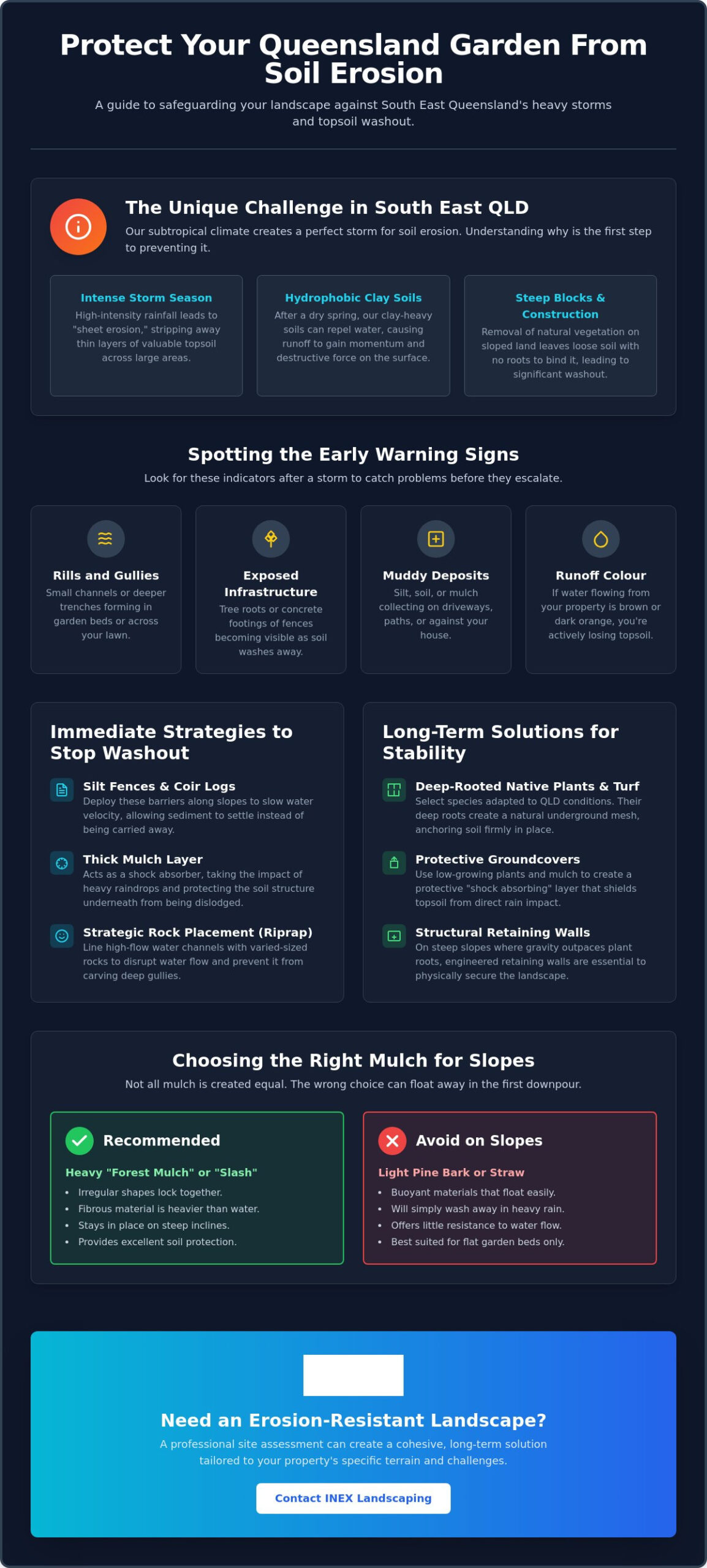
Soil erosion is the physical displacement of the nutrient-rich top layer of your land by water or wind. For homeowners in Greenbank or the wider Logan region, Understanding Soil Erosion is more than just a science lesson; it’s a vital part of property maintenance. When the best part of your garden washes away, you lose the organic matter and minerals that keep your plants thriving. This process doesn’t just leave your garden looking sparse. It can lead to structural damage to garden paths, undermine fences, and cause significant sedimentation in our local SEQ waterways.
The “QLD factor” makes our region particularly vulnerable. Our subtropical climate and the sheer intensity of the summer storm season create unique risks that southern states rarely face. When researching how to prevent soil erosion garden QLD residents often find that their biggest challenges stem from steep blocks or the removal of natural scrub during new home construction. Without vegetation to break the fall of heavy rain or roots to bind the earth, the loose soil simply has nowhere to go but down. Poorly planned drainage often compounds the issue, turning a gentle slope into a high-speed water slide for your expensive mulch and topsoil.
The Impact of the Queensland Wet Season
High-intensity rainfall during a typical December deluge often results in “sheet erosion,” where a thin layer of soil is stripped evenly across a large area. This is exacerbated by our “dry-to-wet” cycle. During a long, parched spring, our local clay-heavy soils can become hydrophobic, meaning they actually repel water instead of absorbing it. When the first big storm hits, the water sits on the surface and gains momentum, stripping away the surface layer with ease. Flash flooding in suburban backyards leads to rapid topsoil loss as concentrated volumes of water channel through garden beds with immense force.
Identifying Erosion in Your Backyard
You don’t need to be a geologist to spot the early warning signs of a problem. Keeping a close eye on your landscape after a storm can save you thousands in remediation costs later. Look for these specific indicators:
- Rills and Gullies: Small channels (rills) or deeper trenches (gullies) forming in garden beds or across lawn areas.
- Exposed Infrastructure: Tree roots that were once underground, or the concrete footings of your fence becoming visible.
- Muddy Deposits: Silt or mulch collecting at the bottom of stairs, on driveways, or against the edges of your home.
- Runoff Colour: If the water flowing off your property is brown or dark orange, you are actively losing your best garden soil.
Immediate Strategies to Stop Topsoil Washout
When the storm clouds gather over Greenbank or Logan, you often have very little time to act. If you’ve noticed your garden beds beginning to migrate toward the street, you need to deploy immediate physical barriers. Silt fences and coir logs are the most effective first line of defence. These tools don’t just stop the soil; they slow down the velocity of the water, allowing sediment to settle rather than being carried away. Learning how to prevent soil erosion garden QLD properties face during a deluge starts with breaking the energy of that moving water. Placing these barriers along the contours of your slope creates a series of mini-dams that keep your valuable topsoil exactly where it belongs.
Mulch also plays a vital role as a shock absorber. Every raindrop that hits bare earth acts like a tiny explosive, dislodging soil particles and making them easier to wash away. A thick layer of mulch takes that hit instead, protecting the soil structure underneath. For areas where water gains significant speed, consider “riprap” or strategic rock placement. By lining high-flow channels with varied-sized rocks, you create a jagged surface that disrupts the water’s flow and prevents it from carving deep gullies into your land. If you’re between projects, a quick cover crop like Japanese Millet can provide a temporary green mesh of roots to hold everything together until you’re ready for a permanent solution.
Choosing the Right Mulch for Slopes
Not all mulch is created equal, especially on a Queensland hill. Many homeowners make the mistake of using light materials like pine bark or straw. These products are buoyant and will simply float away during the first heavy downpour. We recommend using a heavier “forest mulch” or “slash.” These materials feature irregular shapes and fibrous textures that interlock, creating a stable mat that resists movement. Over time, as this organic matter breaks down, it improves the soil’s “grip” and biological health, making it more resilient to future weather events.
Using Geotextiles and Erosion Blankets
For particularly vulnerable areas, geotextiles like jute matting or coir mesh offer immediate surface protection. These biodegradable blankets are pinned directly to the soil, providing a stable surface while your plants establish themselves. You can cut small holes in the mesh to plant your shrubs or groundcovers, allowing the roots to grow through the fabric and eventually take over the job of stabilisation. If your property requires a more robust approach to water management, engaging a professional landscaping team can help you determine whether you need permanent synthetic liners or a more natural, integrated solution.
Biodegradable options typically last between twelve and twenty-four months. This is usually enough time for your garden to develop a self-sustaining root system. In contrast, permanent synthetic liners are reserved for high-velocity drainage areas where vegetation alone will never be enough to withstand the force of the water.
Stabilising Slopes with Native Plants and Turf
While physical barriers provide immediate relief, the most sustainable way to secure your property is through biology. Live roots act as a natural underground mesh, weaving through the soil and anchoring it to the more stable sub-layers. This “root-binding” effect is your best long-term defence against the shifting earth. When considering how to prevent soil erosion garden QLD properties require, native species are almost always the superior choice. These plants have evolved to survive our intense dry spells and the subsequent torrential rains, developing deep taproots and resilient lateral systems that exotic species simply can’t match.
To maximise the effectiveness of your planting, avoid placing shrubs in straight lines. Water is opportunistic; it will quickly find a clear path between rows and begin carving rills. Instead, use a staggered, “zigzag” planting pattern. This layout forces water to weave around the base of each plant, slowing its velocity and allowing more moisture to soak into the ground rather than running off the surface. This method effectively turns your garden bed into a biological filter that traps sediment before it leaves your yard.
Top QLD Native Plants for Erosion Control
- Lomandra (Mat-rush): Often called the gold standard of erosion control, Lomandra features incredibly tough, fibrous roots that can hold even the most precarious banks together.
- Native Sarsaparilla (Hardenbergia): This vigorous groundcover blankets bare earth quickly, providing essential surface protection while its roots establish a firm grip on the soil.
- Creeping Boobialla (Myoporum): An excellent choice for embankments, this dense mat-forming plant suppresses weeds and provides a thick living carpet that prevents soil displacement.
Turf as a Living Shield
In many residential landscapes, a professional natural turf installation provides the most comprehensive surface coverage. A thick, healthy lawn acts as a living shield, preventing “splash erosion” by intercepting raindrops before they can strike the bare earth. By the time the water reaches the soil, its energy has been dissipated by the blades of grass.
Choosing the right variety is crucial for success on a slope. Deep-rooted species like Zoysia or Couch are ideal for the South East Queensland climate, as they offer excellent drought tolerance and a tight growth habit. However, the quality of the installation is just as important as the grass itself. Meticulous soil preparation is required to ensure deep root penetration. Without a properly prepared base, the turf may remain a shallow “mat” that can actually slide off a steep slope during a heavy storm. Ensuring the soil is aerated and enriched allows those roots to dive deep, creating a permanent bond with the hillside.
Structural Solutions: When Plants Aren’t Enough
While native plants and turf are essential, there’s a tipping point where the angle of a slope and the sheer volume of subtropical rain outpace what roots can hold. On steep blocks, gravity eventually wins. This is when structural intervention becomes the only reliable way to secure your property. If you’re looking at how to prevent soil erosion garden QLD landscapes face on hilly terrain, you’ll likely need a combination of engineered support and smart drainage. Hardscaping doesn’t just look good; it “armours” your land against the elements.
Integrating a system of French drains or spoon drains is often the first step in a comprehensive plan. These systems capture surface runoff and move it safely away from vulnerable areas before it can gain enough velocity to strip your topsoil. By controlling the path of the water, you eliminate the random scouring that creates gullies. This proactive management of water flow is what separates a stable garden from one that washes away every January.
Building Effective Retaining Walls
For many Greenbank and Logan homeowners, retaining walls are the most effective solution for transforming steep, eroding banks into stable, level tiers. Timber sleepers are a popular, cost-effective choice for lower heights, while concrete sleepers or sandstone boulders offer a more permanent, heavy-duty alternative for larger heights. These structures physically hold the earth back, creating usable garden space where there was once only a precarious slope. For sloping blocks where a single wall isn’t practical, a tiered garden retaining wall Brisbane south homeowners are increasingly choosing can transform a steep embankment into a series of functional, attractive terraces while keeping costs and council requirements manageable.
The most critical factor in any wall is what you can’t see: the back-drainage. Without proper aggregate and drainage pipes behind the structure, hydrostatic pressure builds up during heavy rain. This pressure is the most common cause of wall failure in Queensland. It’s also vital to consult a professional to ensure your project complies with the specific retaining wall rules in QLD, especially regarding height limits and engineering certifications for structures over one metre.
Paving and Surface Armouring
High-traffic zones or areas where water naturally pools benefit greatly from professional paving installation. By replacing loose soil with a solid surface, you create a permanent barrier against erosion. Permeable paving is a particularly clever option; it provides the stability of a hard surface while allowing water to soak into the substrate, reducing overall runoff and pressure on your drainage system.
Stepping stones and gravel paths also play a role in reducing soil compaction. Compacted soil is less absorbent, which leads to higher runoff rates and increased erosion risk. By directing foot traffic onto stable paths, you keep the surrounding garden beds porous and healthy. If your property has complex slopes that plants alone can’t fix, reaching out for a professional landscape assessment is the best way to ensure your structural solutions are built to last.
Designing an Erosion-Resistant Landscape with INEX
Achieving a stable yard requires more than just a few bags of mulch or a couple of plants. For a long-term solution, a professional site assessment is the essential first step for any Greenbank or Logan property. At INEX, we don’t just look at the surface; we analyse the entire topography to understand how water moves across your land during a typical Queensland deluge. By identifying the source of runoff and its natural path, we can develop a comprehensive strategy for how to prevent soil erosion garden QLD homeowners often struggle with during the summer months. Our approach focuses on resolving the root cause of the washout rather than just treating the symptoms.
The “INEX Approach” is built on the belief that structural integrity and aesthetic design should go hand in hand. You shouldn’t have to choose between a garden that stays put and one that looks beautiful. We integrate custom drainage solutions, such as carefully graded spoon drains or hidden French drains, that are tailored to the unique contours of your land. This ensures that even the heaviest rainfall is managed efficiently, protecting your topsoil while enhancing the overall flow and functionality of your outdoor living space.
Our Local Expertise in Greenbank and Logan
We’ve spent years working with the diverse landscapes of South East Queensland. We understand the specific challenges posed by local soil types, from the heavy, expansive clays found in Marsden to the free-draining sandy loams of Greenbank. Each soil profile requires a different stabilisation technique. Our experience allows us to design landscapes that don’t just solve drainage headaches but also add significant value to your home. We’re committed to consistent quality and building long-term relationships with our clients, ensuring your garden remains a source of pride for years to come.
Next Steps for Your Garden
Transforming your property starts with a vision-first approach. What do you want your outdoor space to look like? Whether you’re dealing with a steep embankment or a flat block that turns into a swamp after rain, we provide a one-stop service to bring that vision to life. From specialised stump grinding and fencing to professional paving and turf installation, we handle every aspect of the project. This integrated service ensures that every element of your new landscape works together to defend against erosion.
Your garden’s defence is only as strong as its weakest point. Once your new landscape is established, we’ll guide you on simple, ongoing maintenance to keep your erosion defences in top shape. This includes regular checks of your drainage outlets and maintaining mulch levels in high-flow areas. Ready to stop the washout and start building a landscape that lasts? Book a consultation with INEX Landscaping today and let’s discuss the potential of your property.
Secure Your Landscape Before the Next Storm
Protecting your property from the volatile Queensland climate requires more than just a quick fix. By combining deep-rooted native plants with engineered structural support like retaining walls, you create a resilient landscape that stands up to subtropical deluges. Effective drainage is the final piece of the puzzle, ensuring water is managed rather than feared. If you’ve been searching for how to prevent soil erosion garden QLD properties often face, you now have the toolkit to transform a vulnerable slope into a stable, attractive asset.
As specialists in the Logan and Greenbank regions, the team at INEX Landscaping understands the unique local soil conditions. We are experts in both structural retaining walls and natural turf installation, providing the comprehensive care your yard deserves. If you have an urgent site need, we even offer same-day service to secure your land quickly.
Get a Professional Landscape Quote for Your QLD Garden
Your garden has incredible potential. With the right strategies in place, you can enjoy a beautiful, functional outdoor space that remains intact for years to come.
Frequently Asked Questions
What is the fastest way to stop soil erosion on a slope in QLD?
The fastest way to halt active erosion is the installation of coir logs or silt fences to slow water velocity immediately. These temporary measures provide instant relief while you plan a more permanent solution like turfing or planting. Adding a layer of heavy, interlocked forest mulch also acts as an immediate shock absorber against heavy raindrops during a sudden storm.
Do I need a council permit to build a retaining wall for erosion control?
In Queensland, you typically need a building permit and engineering certification for retaining walls that exceed one metre in height. Requirements can also vary if the wall is located near a property boundary or is supporting a surcharge load like a driveway or a house. It’s always best to check with your local council, such as Logan City Council or Brisbane City Council, before starting construction.
Which grass variety is best for preventing erosion in South East Queensland?
Zoysia and Couch varieties are highly recommended for South East Queensland due to their deep root systems and dense growth habits. These grasses provide total surface coverage, which is a critical part of how to prevent soil erosion garden QLD landscapes often face during the wet season. Their ability to recover quickly from dry spells makes them a reliable choice for our local climate.
Can I use artificial grass to stop soil erosion?
Artificial grass can be an effective erosion control tool when it’s installed with a professionally prepared, porous sub-base. Because it provides 100% surface coverage immediately, it prevents rain from ever touching the bare soil. However, you must ensure the underlying drainage system is capable of handling the redirected runoff to avoid creating new erosion issues in other parts of your yard.
Why does my mulch keep washing away during summer storms?
Most mulch washes away because it’s too light and buoyant, causing it to float and move with the surface water. Pine bark and straw are common culprits on sloped areas. Switching to a heavier, coarse forest mulch or “slash” is a better strategy. These materials feature irregular shapes that interlock, creating a stable mat that stays put during intense summer storms.
What are the best native Australian plants for binding sandy soil?
For sandy soils, Lomandra longifolia (Mat-rush) and Hardenbergia violacea (Native Sarsaparilla) are exceptional for their deep, binding root systems. Myoporum parvifolium (Creeping Boobialla) also works well as a vigorous groundcover. These native species are adapted to the nutrient-poor conditions of sandy loams and provide the underground mesh needed to hold loose soil together.
How much does a professional erosion control landscape cost?
The cost of a professional erosion control project varies significantly based on the severity of the slope, the chosen materials, and the total area requiring treatment. A simple planting and mulching strategy will differ in price from a project requiring structural retaining walls and complex drainage systems. We recommend a professional site assessment to receive an accurate quote tailored to your property’s specific topography.
Is it better to use rocks or plants to stabilise a garden bank?
A hybrid approach that uses both rocks and plants usually yields the best results for garden banks. Rocks or “riprap” are excellent for armouring high-velocity drainage channels where plants might be washed away. Meanwhile, deep-rooted native plants provide long-term biological stability for the surrounding soil. This combination ensures your bank is protected both mechanically and biologically against the elements.