
What if your brand-new one-metre wall was actually illegal before the first sleeper was even laid? Most homeowners assume height is the only factor for council intervention, but the reality of retaining wall rules qld is far more nuanced. You’ve likely spent hours squinting at confusing council websites or worrying about whether a new terrace might cause drainage issues for your neighbours. It’s a lot of pressure when you’re simply trying to improve your property’s value and safety.
We’ve put this guide together to give you total confidence in your next outdoor project. We promise to help you master the complex council regulations and engineering requirements for 2026, ensuring your wall is legal and built to last. We’ll provide a clear “Yes/No” on building approvals, explain hidden triggers like surcharge loading, and clarify the cost-sharing rules with neighbours. By the end, you’ll have a logical roadmap to create a compliant, professional structure that enhances your home for decades.
Key Takeaways
- Identify when a 1-metre wall still requires a permit due to surcharge loads or proximity to other structures.
- Master the essential retaining wall rules qld regarding the “zone of influence” to ensure your project remains safe and compliant.
- Clarify legal responsibilities for boundary walls and how to manage stormwater flow without breaching Queensland property laws.
- Discover how local soil conditions in Logan and Greenbank influence the engineering and material choices for a long-lasting build.
The 1-Metre Rule: When is a Retaining Wall Exempt from Approval?
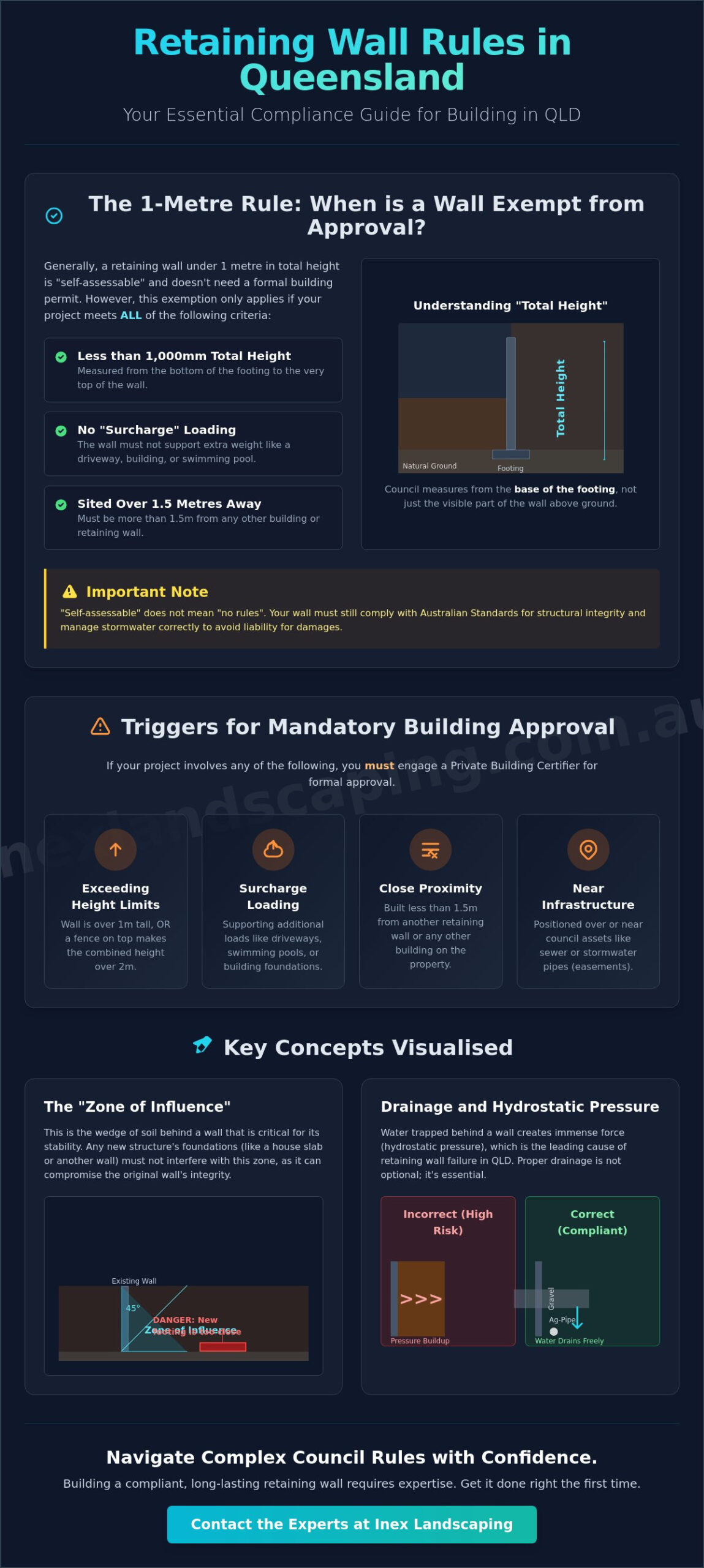
Under the National Construction Code, retaining walls are classified as Class 10b structures. This classification means they’re considered non-habitable structures, but they still carry significant structural responsibility. For most homeowners, the most important part of retaining wall rules qld is the 1-metre threshold. Generally, if your wall is less than 1,000mm in height, it’s considered “self-assessable” and doesn’t require a formal building permit from a certifier.
However, “total height” is a term that catches many people out. Council doesn’t just measure the part of the wall you can see. They look at the entire vertical structure from the bottom of the footing to the very top. If you decide to bolt a timber fence to the top of your 800mm wall, the combined height will likely exceed the limit, triggering a mandatory approval process. You must also consider the 1.5-metre proximity rule; if your wall is close to a house or another wall, it may need a permit regardless of its height.
The Basic Exemption Criteria
To build without a permit, your project must tick several specific boxes. It isn’t just about grabbing some sleepers and getting to work. Your wall must meet these standards:
- The total height must be less than 1,000mm from the natural ground level.
- The structure must not support a “surcharge” loading, such as a driveway, a swimming pool, or a building’s foundations.
- The wall must be located further than 1.5 metres from any other building or existing retaining wall.
Why “Self-Assessable” Does Not Mean “No Rules”
Even if you don’t need a building certifier to sign off on the paperwork, you’re still legally required to build a safe structure. Every wall in Queensland must comply with Australian Standards for structural integrity. If a wall fails because it wasn’t designed correctly, the owner is often liable for any damage caused to neighbouring properties. Understanding retaining wall rules qld also means managing your stormwater. You cannot legally concentrate water flow or divert it in a way that creates a nuisance for your neighbour.
Proper drainage behind the wall is essential to prevent hydrostatic pressure, which is the leading cause of wall collapse in South East Queensland’s heavy summer rains. Natural ground level is defined as the surface of the land in its original state before any excavation or filling took place.
Triggers for Mandatory Building Approval in QLD
Understanding when you need retaining wall building approval involves more than just a tape measure. While height is the most common trigger, the state’s building regulations identify several high-risk scenarios that require professional oversight. If your project falls into these categories, you’ll need to engage a Private Building Certifier. These experts act as the bridge between your vision and the law. They ensure everything meets the retaining wall rules qld before any soil is moved.
One common trap involves fences. If you build a fence on top of a wall and the combined height exceeds 2 metres from the natural ground level, you must seek approval. This rule exists because a fence acts like a sail. It catches the wind and transfers that force directly into the wall’s structure. Without proper engineering, the entire assembly could lean or fail during a storm. A certifier will check that your footings are deep enough to handle this extra leverage.
The Surcharge Loading Trigger
A surcharge is any extra weight placed on the soil behind or above your wall. Think of driveways, swimming pools, or heavy garden sheds. This additional pressure changes how the soil behaves. Even a 600mm wall might require engineering if it’s supporting a car-parking area; in such instances, you may need to discover ML Traffic Engineers Australia to ensure your transport planning and property access meet all regulatory requirements. In these cases, simple gravity walls won’t cut it. You’ll likely need reinforced concrete or steel-integrated designs to handle the load safely. It’s a matter of long-term stability for your property and your neighbour’s land.
Building Near Infrastructure and Easements
Building near the boundary often means building near hidden assets. If your wall sits over or near sewer and stormwater mains managed by Unitywater or Logan Water, the approval process gets more detailed. You’ll likely enter a “referral agency” process. This is where the utility provider assesses if your wall’s footings might crush their pipes. Always “dial before you dig” to locate these services. If you’re feeling overwhelmed by these requirements, a team that specialises in retaining walls can help you navigate the paperwork and the build. It’s about getting the job done right the first time.
Siting, Setbacks, and the Zone of Influence
While height and triggers define the legal paperwork, siting defines the physical success of your build. You need to look beyond the visible wall and consider the invisible forces acting on your land. In South East Queensland, the retaining wall rules qld mandate that your entire structure, including the concrete footings and the drainage gravel behind it, must sit completely within your property boundary. If any part of the base crosses the line, you’re encroaching on your neighbour’s land, which can lead to expensive legal disputes or the forced removal of the wall.
The “Zone of Influence” is perhaps the most critical concept to understand. Imagine a line drawn at a 45-degree angle from the bottom of your wall’s footing up through the soil. Any structure sitting within that triangle, like your home’s foundation or a neighbour’s pool, is relying on that soil for support. If your wall isn’t engineered to handle that specific pressure, you risk causing foundation cracking or structural subsidence. It’s why we meticulously plan the placement of every sleeper and block to ensure the earth remains stable.
The 45-Degree Rule Explained
Soil doesn’t just sit flat; it wants to slump at a natural angle. This is often called the “angle of repose.” When you build a wall, you’re effectively catching a triangle of soil that wants to slide down. If you place a heavy object, like a garden shed or a large tree, at the top of that slope, you’re increasing the weight the wall has to hold. If you’re planning tiered walls to create a grander landscape, you must space them correctly. A good rule of thumb is to keep the walls apart by at least twice the height of the lower wall to avoid “compounding” the load.
Boundary Setbacks and Ownership
In many Logan and Brisbane suburbs, a standard 600mm minimum clearance from side boundaries is recommended. This gap isn’t just a suggestion; it’s practical space for you to maintain the wall and clear out drainage pits without stepping onto the next block. Building exactly on the boundary line changes the legal status of the wall and often requires a formal agreement with your neighbour. Footings cannot “encroach” onto a neighbour’s property without an easement, so always double-check your survey pegs before pouring concrete.
Following these siting rules ensures your project adds value rather than liability. It’s about being a good neighbour while protecting your own investment for the long term.
Drainage Requirements and Neighbourly Responsibilities
Water is a wall’s worst enemy. In Queensland, poor drainage is the leading cause of retaining wall failure, often leading to costly repairs and strained relationships between neighbours. Under the current retaining wall rules qld, you have a legal “duty of care” to ensure your structure does not negatively impact the properties around you. This includes a strict prohibition on “concentrating” stormwater flow. You cannot simply install a pipe that dumps all your backyard runoff directly onto your neighbour’s lawn. Instead, you must manage water responsibly within your own boundaries.
Determining who pays for a wall often causes confusion. Unlike a standard boundary fence, a retaining wall usually serves the specific purpose of supporting a “cut” or a “fill” on one person’s land. The “beneficiary principle” applies here; the person who altered the natural state of the land to create a flat area is typically responsible for the construction and maintenance costs. If you are the one benefiting from the level ground, the bill generally sits with you.
Critical Drainage Components
A professional build requires more than just stacking blocks. Behind the wall, we install a dedicated drainage system consisting of perforated agricultural (ag) pipe wrapped in geofabric and surrounded by clean drainage gravel. The geofabric acts as a filter, preventing fine soil from clogging the pipe over time. We also incorporate “weep holes” in the face of the wall to allow trapped moisture to escape. This prevents the buildup of hydrostatic pressure, which can exert thousands of kilograms of force against the structure. All drainage must eventually connect to a legal point of discharge, such as the street kerb or an existing stormwater system. Pairing a well-drained wall with broader garden strategies is equally important; learning how to prevent soil erosion in your QLD garden will help you protect the topsoil and landscaping on both sides of the structure.
Managing Neighbour Disputes
It is a common misconception that the Neighbourhood Disputes (Dividing Fences and Trees) Act 2011 covers retaining walls. In reality, this Act specifically excludes retaining walls unless they are integral to the support of a fence. Because the legalities differ, we always recommend talking to your neighbours before work begins. If the wall is on the boundary, you may need to provide a “Form 3” or a similar notice depending on your local council requirements. If you’re unsure how to approach a boundary project or need a system that handles heavy Queensland rain, our team specialises in compliant, high-quality retaining walls designed for local conditions.
If you discover a neighbour’s wall is failing and threatening your property, the first step is a polite conversation. However, since the retaining wall rules qld place the maintenance burden on the beneficiary, you may need to seek legal advice or council intervention if the owner refuses to address the structural risk.
Building a Compliant Retaining Wall in Logan and Greenbank
Local knowledge is what separates a wall that lasts a decade from one that lasts a lifetime. While the retaining wall rules qld provide the legal framework, the specific geology of Logan and Greenbank dictates the physical design. This region is known for its reactive clay soils. These clays expand significantly when wet and contract during dry spells, creating a shifting foundation that can easily buckle a poorly designed wall. You need a structure that accounts for this movement from the very first day.
Logan City Council’s planning schemes also include specific overlays that might affect your property. Whether you’re in a bushfire-prone area or near a waterway, these local factors influence your material choices and siting. Choosing the right materials is your first line of defence against the elements. While timber sleepers are a cost-effective entry point, they often struggle with the humidity and termite pressure of South East Queensland. For those looking for a permanent solution, concrete sleepers or reinforced Besser blocks offer a lifespan of 50 years or more. High-quality structural outdoor construction, as seen on cascadeoutdoorservices.com, always relies on selecting materials suited to the specific environment.
Local Soil and Climate Considerations
- Reactive clay soils require deeper footings and superior drainage to handle the expansion and contraction cycles common in Greenbank.
- Heavy-duty galvanised steel posts are essential for sleeper walls to prevent the “leaning” effect often seen in older timber-post designs.
- Humidity and high rainfall mean that even “treated” timber can fail within 10 to 15 years, whereas concrete and masonry remain structurally sound.
The INEX Landscaping Approach
We don’t just start digging; we plan for excellence. Our process begins with thorough site preparation, including site clearing and specialised stump grinding to ensure your wall’s foundation is free from organic debris that could rot and cause subsidence. We understand that compliance with retaining wall rules qld isn’t optional. It’s a commitment to your home’s safety. For any project exceeding the 1-metre threshold, we work closely with certified structural engineers to guarantee your peace of mind and full council approval.
Our team handles every granular detail, from the first soil test to the final drainage connection. We take pride in our meticulousness, ensuring your project is a stable, beautiful fixture of your property. If you’re ready to transform your landscape with a wall that meets every standard, you can get a professional quote for your Greenbank retaining wall project today. We’re here to be your reliable partner in building a better outdoor environment.
Secure Your Property’s Future with a Compliant Build
Building a retaining wall is a significant investment that transforms how you use your land. By understanding the retaining wall rules qld, you’ve taken the first step toward a project that’s safe, legal, and adds genuine value to your home. You now know that height is only part of the story. Managing the zone of influence and ensuring proper drainage are what keep your wall standing through the toughest Queensland summers.
As specialist retaining wall builders in Logan and Greenbank, we take the guesswork out of council regulations and engineering. Our team provides a full-service experience, from initial stump grinding and site clearing to the final turf laying. We’re dedicated expert craftsmen who treat your property with the meticulousness it deserves.
Ready to start your transformation? You can Request a Site Inspection and Quote from INEX Landscaping today. We’ll help you navigate the complexities and deliver a result you can be proud of for decades to come. Your dream landscape is well within reach.
Frequently Asked Questions
How high can a retaining wall be without a permit in QLD?
A retaining wall in Queensland generally doesn’t require a building permit if it’s under 1 metre in height from the natural ground level. This exemption only applies if the wall isn’t supporting a surcharge load or located within 1.5 metres of another structure. You should always verify your specific site conditions before starting, as these factors can trigger a mandatory approval process even for shorter walls.
Who is responsible for a retaining wall on a boundary line in Queensland?
Responsibility usually falls on the property owner who altered the land’s natural state to create a benefit. If you “cut” into a slope to level your yard or “fill” an area to raise it, you’re the beneficiary responsible for the wall’s costs and maintenance. Retaining walls are not governed by the Dividing Fences Act, so the shared-cost rules for standard fences don’t automatically apply here.
Do I need an engineer for a 1-metre retaining wall?
You’ll generally need a structural engineer if the wall exceeds 1 metre or if it’s supporting extra weight like a driveway or a pool. Even for a wall exactly 1 metre high, local retaining wall rules qld might require engineering if the soil is highly reactive clay or if the wall is part of a tiered system. Professional engineering ensures the wall can withstand the specific soil pressures on your block.
Can I build a retaining wall myself in Logan or Greenbank?
You can DIY a small, exempt retaining wall, but projects requiring building approval often require a licensed contractor or an owner-builder permit. In Logan and Greenbank, any work over a certain value, typically $3,300, requires a licensed professional to ensure compliance with the Queensland Building and Construction Commission standards. Hiring a specialist ensures the structural integrity and longevity of the build.
What is the “Zone of Influence” for a retaining wall?
The Zone of Influence is the area of soil behind and below a wall that is being supported by the structure. If you place a heavy load, like a garden shed or a house footing, within this zone, it increases the pressure on the wall. Understanding this concept is vital to prevent foundation movement or wall failure caused by surcharge loads that weren’t accounted for in the original design.
Does a retaining wall need a fence on top for safety?
Queensland safety standards typically require a child-resistant barrier or fence if there is a risk of a person falling 1 metre or more. While the wall itself provides structural support, the drop it creates is a safety hazard that must be addressed. If you add a fence on top, remember that the combined height may trigger the need for a building permit under current retaining wall rules qld.
How much does a building permit for a retaining wall cost in QLD?
Building permit costs vary depending on the complexity of the project and the fees charged by your chosen Private Building Certifier. You’ll need to pay for the certifier’s time, council lodgement fees, and potentially a structural engineer’s design if the wall is complex. It’s best to request a quote from a certifier once you have your basic plans and site details ready.
Can my neighbour build a retaining wall that blocks my drainage?
No, a neighbour cannot legally build a structure that concentrates or diverts stormwater in a way that causes a nuisance to your property. Queensland common law and local council ordinances require all property owners to manage their runoff responsibly. If a new wall blocks your existing drainage path, the neighbour may be liable for any damage or water pooling issues that arise on your land.